We’ve all seen the ads. They promise you a homeowner’s insurance quote in fifteen minutes, ten minutes, maybe even five. They turn the complex financial safety net of your biggest asset into a fast-food menu item. Click a few buttons, check a few boxes, and voilà—you’re “covered.”
But here is the question that keeps actual insurance experts up at night: If you check a box without knowing what’s inside it, are you really protected?
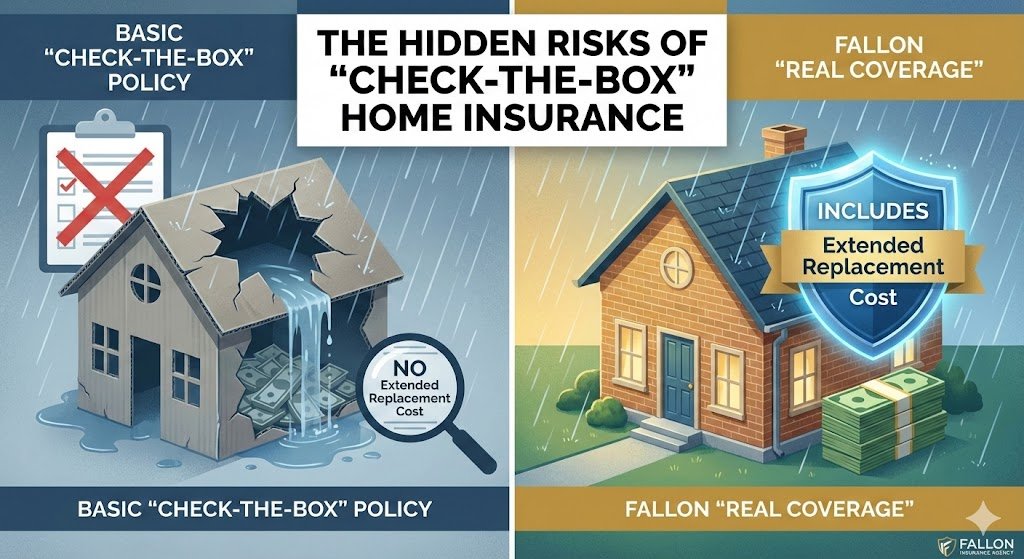
In the insurance industry, we call this “check-the-box” coverage. It’s a policy designed to meet the minimum requirements of your mortgage lender or to show you the lowest possible number on a premium screen. It looks fantastic on paper when you’re paying your monthly bill. But the moment a disaster actually strikes—when a kitchen fire spreads to the attic or a storm tears through your roof—that cheap policy often reveals itself to be a financial trap door.
At Fallon Insurance Agency, we believe that “good enough” coverage usually isn’t enough when reality hits. Today, we need to talk about the most dangerous gap we see in these generic policies: the lack of Extended Replacement Cost.
The Illusion of the “Cheapest” Quote
Let’s start with a hard truth: Insurance isn’t a commodity. It’s not like buying a gallon of milk where the cheaper jug is identical to the expensive one. Insurance is a contract. When you buy a policy solely based on price, you are almost certainly agreeing to transfer less risk to the insurance company and keep more risk for yourself.
The most common way cut-rate insurers lower your premium is by tightening the definition of what they will pay to rebuild your home.
Imagine you bought your house in a quiet suburb of Milwaukee or a rural spot near Cannon Falls for $350,000. Your “check-the-box” policy insures the dwelling for $350,000. That seems logical, right?
But then, a disaster happens. It’s not just your house; maybe a storm swept through the whole county. Suddenly, every contractor in Minnesota and Wisconsin is booked solid. The price of lumber spikes because of supply chain issues. The cost of labor doubles because crews are in such high demand.
Your contractor looks at the damage and tells you it will cost $450,000 to rebuild your home the way it was.
If you have a standard policy, the insurance company writes you a check for your limit: $350,000. The remaining $100,000? That comes out of your retirement fund, your children’s college savings, or a high-interest loan.
This isn’t a scare tactic; it is a mathematical reality of the construction market. Rebuilding a single home almost always costs more than building twenty homes in a new subdivision, and inflation rarely waits for your policy renewal to strike.
Enter: Extended Replacement Cost
This is where the concept of Extended Replacement Cost changes everything. It is the specific feature that separates “Real Coverage” from a piece of paper that just satisfies your bank.
Extended Replacement Cost is a safety buffer. It is an endorsement (an add-on to your policy) that agrees to pay more than your policy’s stated limit if the cost of construction surges.
Typically, this coverage adds an extra 25% or 50% on top of your dwelling coverage.
Let’s go back to that nightmare scenario:
- Policy Limit: $350,000
- Actual Rebuild Cost: $450,000
Without Extended Replacement Cost: You pay the $100,000 gap. With 50% Extended Replacement Cost: Your policy can stretch up to $525,000 ($350,000 + 50%).
In this scenario, the insurance company covers the entire $450,000 bill. You pay your deductible, and you move back into your fully restored home. Your savings stay in the bank.
Why Do Cheap Policies (Check-the-Box) Skip This?
If Extended Replacement Cost is so vital, why isn’t it on every policy?
The answer is simple: Price wars.
Aggregator websites and direct-to-consumer insurers are fighting to show you the lowest number possible. Adding Extended Replacement Cost increases the premium slightly—often by less than the cost of a streaming subscription per month—but in the war for the “cheapest quote,” that slight increase makes them look uncompetitive.
So, they strip it out. They give you a “Standard Replacement Cost” policy. They rely on the fact that you probably won’t read the fine print until your house is already gone. They are betting on the best-case scenario; at Fallon Insurance Agency, we plan for the worst-case scenario.
The “Demand Surge” Factor
Living in the Midwest, we are no strangers to weather that affects entire communities at once. Whether it’s heavy snow loads in Wisconsin or severe storms sweeping across the plains of Iowa and Minnesota, disasters here rarely happen in isolation.
When a major event damages hundreds of homes at once, “Demand Surge” kicks in.
- Materials vanish: You are competing with 500 other families for the same drywall and shingles.
- Labor evaporates: Local contractors are booked for months, forcing you to bring in expensive out-of-state crews.
- Permit delays: Local governments get overwhelmed, slowing down the process and increasing rental home costs (which is another coverage gap we often see!).
A standard Home Insurance policy limit is calculated based on a sunny day with normal market rates. It does not account for the chaos of a catastrophe. Extended Replacement Cost is designed specifically for that chaos. It acknowledges that the price of a 2×4 piece of lumber today might be $3, but after a massive storm, it might be $8.
The Fallon Difference: “Real Coverage”
This brings us to the core of what we do at Fallon Insurance Agency. We don’t just sell insurance; we architect protection.
When we say we offer “Real Coverage,” we mean coverage that holds up when you actually need to file a claim. We serve Minnesota, Wisconsin, and Iowa—we live here, we drive these roads, and we know these houses.
We know that a “generic” insurance plan built by an algorithm in Silicon Valley doesn’t account for the specific realities of our region. It doesn’t ask, “What if the lumber price spikes again like it did in 2021?”
When you come to us, we don’t just ask for your address and spit out a price. We perform Quote Reviews. We look at your current policy, or the quotes you’re comparing, and we hunt for the dangerous gaps.
- Does this quote have Extended Replacement Cost?
- Is the water backup coverage sufficient for a finished basement?
- Is the roof covered for replacement cost or just “actual cash value” (a depreciated amount that leaves you with a massive bill for an old roof)?
We are often able to find these gaps and close them, sometimes for a comparable price to what you were already paying for inferior coverage. By bundling your home and auto, or by leveraging our relationship with top-tier carriers like Farmers Insurance, we can often structure a policy that includes Extended Replacement Cost without breaking your budget.
The Human Element
Computers are great at math, but they are terrible at empathy. An algorithm doesn’t care if you are underinsured by $50,000. It doesn’t feel the stress of a family displaced by a fire.
That is why “Check-the-Box” insurance is so risky. It removes the human expert from the equation.
When you work with a local agent—someone who actually answers the phone when you call—you get a partner who asks the right questions. We might ask about the custom cabinetry in your kitchen or the finished square footage in your basement that the county tax records missed. These details matter. They are the difference between a full recovery and a financial disaster.
A Challenge to Homeowners
If you are reading this and you aren’t sure if you have Extended Replacement Cost, I challenge you to pull out your policy declaration page right now.
Look for terms like “Additional Replacement Cost,” “Extended Dwelling Coverage,” or “Increased Replacement Cost.”
If you don’t see them—or if you see a standard “100%” replacement cost with no buffer—you are carrying a hidden risk. You are effectively self-insuring against inflation.
Don’t wait for a claim to find out what you checked the box for. Coverage that looks “good enough” on a Tuesday afternoon feels woefully inadequate on a Wednesday morning after a fire.
Conclusion: Don’t Just Get a Quote, Get Clarity
Your home is likely your most valuable asset. Protecting it shouldn’t be about finding the absolute lowest dollar amount per month; it should be about finding the most efficient way to ensure that asset can be replaced, no matter what the economy or the weather does.
At Fallon Insurance Agency, we are rewriting what great coverage looks like. From Cannon Falls to Milwaukee, we are helping homeowners trade “check-the-box” anxiety for the peace of mind that comes with Extended Replacement Cost.
Stop guessing. Stop hoping the algorithm got it right. Contact us today for a quote review. Let’s make sure that if the worst happens, the only thing you have to worry about is the color of paint for your new living room—not how you’re going to pay for the walls.