



Why Getting Minnesota Mortgage Insurance Right Matters More Than You Think
Minnesota mortgage insurance comparison comes down to three main options: Private Mortgage Insurance (PMI) for conventional loans, Minnesota Housing’s HFA Preferred/Advantage programs with lower MI rates, and government-backed loans (FHA/VA) with their own insurance requirements. The key differences are cost, cancellation rules, and down payment requirements—and choosing wrong can cost you thousands over the life of your loan.
Here’s what you need to know:
| Type | Down Payment | Monthly Cost (Example) | Can You Cancel? |
|---|---|---|---|
| Standard Conventional PMI | 3-19% down | $166/month | Yes, at 80% LTV |
| HFA Preferred/Advantage | 3% down | $126/month | Yes, at 80% LTV |
| FHA Mortgage Insurance | 3.5% down | Varies | No (most cases) |
| Upfront Paid MI | 3% down | $0/month (higher rate) | N/A |
Based on $260,000 purchase price, 700 credit score, ≤80% area median income
Most people don’t realize Minnesota has state-specific advantages for PMI cancellation. If you have a Minnesota-chartered lender, you can cancel PMI based on your home’s current market value—not just the original purchase price. That means if your home appreciates, you could drop PMI years earlier than federal law requires.
But here’s the catch: mortgage insurance is only part of your total housing cost. Homeowners insurance in Minnesota averages $1,829 per year—4% higher than the national average—and rates jumped 21% between 2022 and 2023 due to extreme weather, labor shortages, and rising construction costs. When you combine mortgage insurance with property insurance, small differences in rates and coverage can swing your monthly payment by hundreds of dollars.
I’m Leland Fallon, and I’ve helped families across Minnesota navigate these exact decisions—comparing mortgage insurance options, understanding cancellation rights, and pairing the right homeowners coverage with their loan requirements. Whether you’re evaluating a Minnesota mortgage insurance comparison or trying to figure out when you can drop PMI, the goal is the same: protect your home without overpaying.
Understanding Minnesota Mortgage Insurance Options
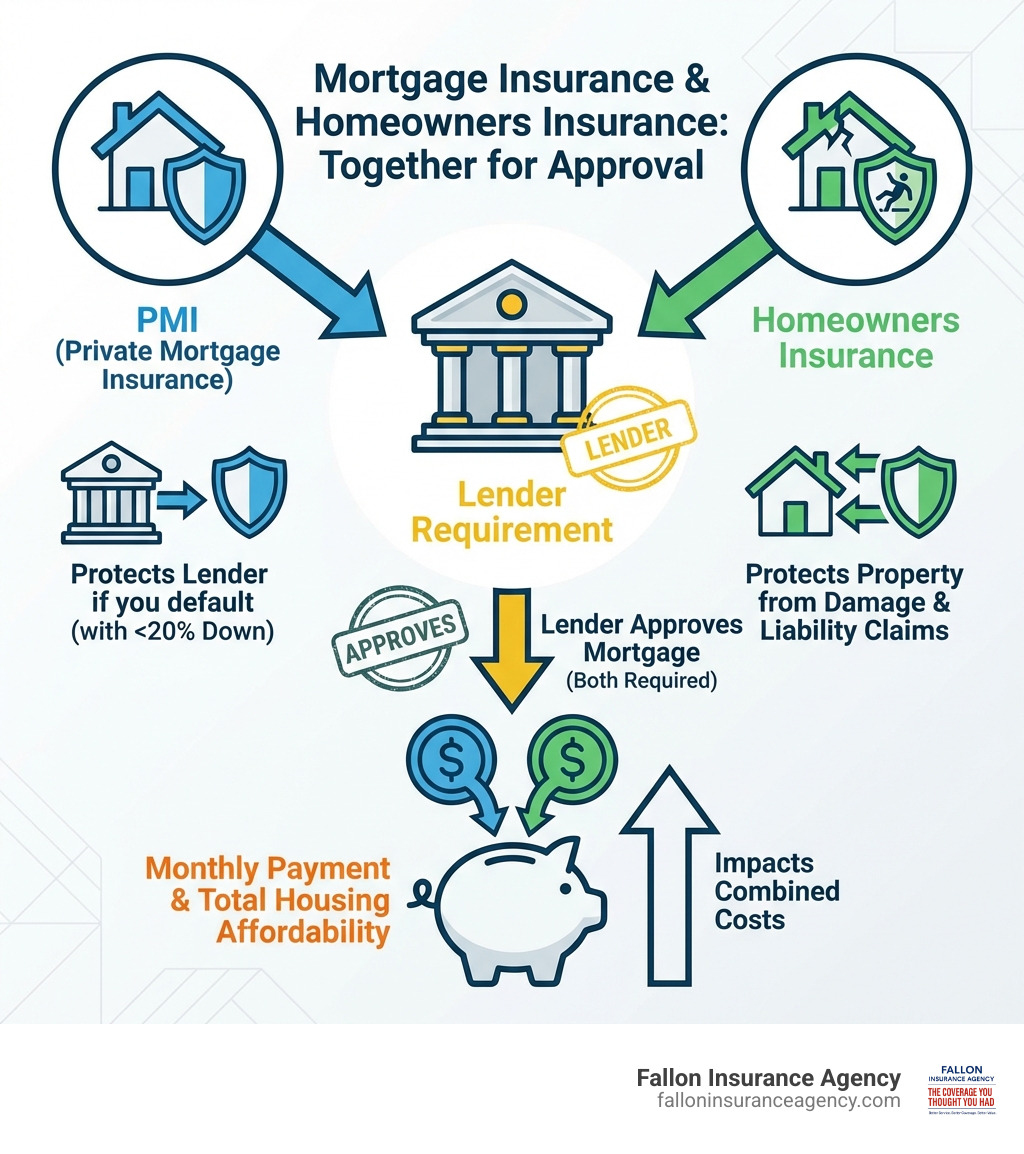
When you’re looking at your monthly mortgage statement, that “PMI” line item can feel like a punch in the gut. But before we get into how to save, we need to understand what it actually is. Private Mortgage Insurance (PMI) is a policy that protects the lender—not you—in case you stop making payments. If you put down less than 20% on a conventional loan, the bank sees you as a higher risk.
In Minnesota, PMI costs typically range from $35 to over $100 per month, depending on your loan amount and credit score. This money is usually collected as part of your monthly mortgage payment and held in an escrow account.
According to the Private Mortgage Insurance Fact Sheet provided by the Minnesota Attorney General, it’s vital to remember that PMI isn’t life insurance or disability insurance. It won’t pay off your mortgage if you get sick or pass away; its only job is to make sure the bank doesn’t lose its shirt if the house goes into foreclosure.
Comparing Conventional and Government-Backed Mortgage Insurance
When we do a Minnesota mortgage insurance comparison, we aren’t just looking at standard conventional loans. Minnesota Housing offers exclusive products like the Fannie Mae HFA Preferred and Freddie Mac HFA Advantage programs. These are “game-changers” for local buyers.
- Standard Conventional MI: On a $260,000 home with 3% down, you might pay around $166.03 a month. Over five years, that’s nearly $10,000.
- HFA Preferred/Advantage: These programs offer reduced MI rates. For that same home, the monthly cost drops to about $126.10. That’s a savings of $2,395.80 over five years.
- Upfront Paid MI: You can choose to pay the entire premium at closing. While this increases your interest rate slightly, it eliminates the monthly MI payment entirely. For some, this results in the lowest possible monthly payment, though it has more restrictive eligibility.
Government-backed loans like FHA are different. They require a Mortgage Insurance Premium (MIP) that usually lasts for the entire life of the loan if you put down less than 10%. This is why many of our clients in Minneapolis and St. Paul strive to qualify for conventional HFA programs—they want the ability to eventually “fire” their mortgage insurance.
When and How You Can Cancel Mortgage Insurance in Minnesota
This is where being a Minnesotan pays off. Most people know the federal rule: you can request PMI cancellation when your loan-to-value (LTV) ratio hits 80% of the original purchase price.
However, Minnesota law provides a massive loophole for loans from Minnesota-chartered lenders. Under state law, you can often cancel PMI based on the current market value of your home.
Imagine you bought a home in Eagan for $300,000. Five years later, thanks to a hot market, it’s worth $380,000. Even if you haven’t paid the principal down to $240,000 (80% of the original price), you might already have 20% equity based on that new $380,000 value.
Steps to cancel PMI in Minnesota:
- Check your lender’s charter: Is it a national bank or a Minnesota-chartered one?
- Watch your value: Keep an eye on local sales in Bloomington or Lakeville.
- Order an appraisal: You’ll likely need to pay for a professional appraisal to prove the new value.
- Request in writing: Send a formal request to your lender.
Don’t wait for the bank to tell you. They are required to terminate PMI automatically once you reach 78% LTV of the original price, but that could take a decade or more if you only make minimum payments.
Minnesota Down Payment and Closing Cost Assistance Programs
If the upfront costs are keeping you from buying, Minnesota Housing has some of the best assistance programs in the country. We frequently see these paired with the Start Up (for first-time buyers) and Step Up (for move-up buyers) programs.
There are three main “flavors” of assistance:
- Monthly Payment Loan: You can borrow up to $18,000. It has the same interest rate as your first mortgage and is repaid over 10 years.
- Deferred Payment Loan (DPL): This provides up to $14,000. It has a 0% interest rate. You don’t make monthly payments; instead, the loan is repaid as a “balloon” when you sell the house, refinance, or pay off your primary mortgage.
- Deferred Payment Loan Plus (DPL+): This is for buyers who meet specific “targeting” criteria (like being a first-generation homebuyer). It offers up to $18,000 with the same 0% deferred terms as the standard DPL.
Who Qualifies for Assistance?
These programs aren’t just for anyone; they are designed to help those who truly need it.
- Income Limits: These vary by county but are generally generous enough to include many working families in the Twin Cities.
- Asset Limits: For the DPL+, your post-closing liquid assets cannot exceed $13,000.
- The “Spend Down” Rule: If you have $15,500 in the bank (putting you $2,500 over the limit), Minnesota Housing allows you to “spend down” that excess by paying off existing debts—like a credit card or car loan—before closing.
- Homebuyer Education: At least one borrower must complete an approved course (like Framework or Home Stretch) before closing.
- Minimum Contribution: You must contribute the lesser of $1,000 or 1% of the purchase price from your own funds.
How Homeowners Insurance Affects Your Mortgage Approval
When we talk about Minnesota mortgage insurance comparison, we have to talk about homeowners insurance. Lenders calculate your Debt-to-Income (DTI) ratio based on your full “PITI” payment: Principal, Interest, Taxes, and Insurance. If your insurance quote comes back too high, it could actually disqualify you from the loan you wanted.
Insurance in Minnesota is getting more expensive. Between 2017 and 2023, premiums spiked 39.1%. We are now the 13th most expensive state for home insurance, with an average premium of $1,607 (though many of our clients see closer to $1,800+ for $300k in coverage).
| City | Average Annual Premium (Est.) | Comparison to State Avg |
|---|---|---|
| Minneapolis | $2,010 | +10% |
| St. Paul | $1,985 | +8% |
| Rochester | $1,729 | -5% |
| Duluth | $1,810 | -1% |
| Statewide Average | $1,829 | 0% |
Source: Research data for $300,000 dwelling coverage
Why the high costs? It’s the weather. Since 1980, Minnesota has been hit by 62 weather disasters causing over $1 billion in damage each. From the “derecho” storms to massive hail events, insurers are paying out more than ever. In fact, between 2017 and 2022, insurers reported losses in Minnesota every single year.
Dealing with High-Risk Properties in Minnesota
Sometimes, a house has a “wrap sheet.” If a property has had multiple claims for water damage or roof replacement in the last few years, many standard insurance carriers might decline to cover it.
If you find yourself with a property that’s hard to insure, you might end up with the Minnesota FAIR Plan. This is the state’s insurer of last resort. It currently covers about 3,690 high-risk properties. The premiums are high and the coverage is basic, so we always recommend exhausting every other option first.
One trend we’re seeing is the “separate deductible.” Many insurers are now moving toward a separate (and much higher) deductible for wind and hail damage. Instead of a flat $1,000 deductible, you might have a 1% or 2% deductible for storms. On a $400,000 home, that’s an $8,000 out-of-pocket cost before the insurance kicks in. This is why we walk our clients through “what if” scenarios—so you aren’t surprised by an $8,000 bill after a July hailstorm.
Practical Ways to Lower Your Total Housing Costs
You can’t control the weather, but you can control how you present your risk to the insurance company. Here’s how we help our clients save:
- Bundle Home and Auto: This is the single biggest lever. Bundling can save you up to 25% across both policies.
- Raise Your Deductible: If you can afford a $2,500 deductible instead of $1,000, your annual premium will drop significantly. Just make sure you actually have that $2,500 sitting in an emergency fund!
- The New Roof Discount: If the home you’re buying just had a new roof installed, tell us. Insurers love new roofs because they are less likely to leak during a storm.
- Security Systems: A professionally monitored alarm system or even smart home water leak detectors (which many insurance carriers now provide) can trigger discounts.
- Credit Matters: In Minnesota, insurers use credit-based insurance scores. A poor credit score can make your insurance cost thousands more per year. Improving your score doesn’t just help your mortgage rate; it slashes your insurance bill too.
Frequently Asked Questions about Minnesota Mortgages
Can I cancel PMI early if my home’s value goes up?
Yes, especially in Minnesota. If your lender is Minnesota-chartered, they are required by state law to consider the current market value (appreciation). If you’ve seen significant gains in neighborhoods like Woodbury or Bloomington, you should call your lender and ask for an appraisal to drop that monthly PMI.
What’s the difference between DPL and DPL+ assistance?
Both are 0% interest deferred loans from Minnesota Housing. The standard DPL offers up to $14,000. The DPL+ offers up to $18,000 but requires you to meet specific targeting criteria, such as being a first-generation homebuyer or meeting certain housing ratio requirements (minimum 28%).
Does standard Minnesota home insurance cover flooding from snowmelt?
No. This is a common and dangerous misconception. Standard homeowners insurance excludes “surface water” flooding. With 10,000 lakes and heavy snowmelt every spring, many Minnesota homes are at risk. You need a separate policy through the National Flood Insurance Program (NFIP) or a private carrier. Even if you aren’t in a “high-risk” zone, 40% of flood claims come from low-to-moderate risk areas.
Conclusion
At Fallon Insurance Agency, we don’t believe in just finding the “cheapest” policy. We believe in protection that actually works when the sky turns green and the sirens start wailing. Whether you are doing a Minnesota mortgage insurance comparison to save $40 a month on PMI, or you’re trying to figure out if your wind/hail deductible is going to bankrupt you after a storm, we’re here to give you the straight scoop.
We serve families from Duluth to Rochester and everywhere in between. Our goal is simple: no surprises. We want you to understand your coverage before a claim happens, not after.
If you’re ready to look at your total housing protection—from mortgage insurance options to the best home and auto bundles in the Midwest—let’s chat. We’ll walk you through the “what ifs” so you can sleep soundly, even during a Minnesota blizzard.
Protect your Minnesota home with Fallon Insurance Agency

Leland Fallon
Leland Fallon is the founder of Fallon Insurance Agency, dedicated to protecting families across the Midwest. His mission is simple: make sure no family ever finds out they were underinsured after it’s too late. By uncovering hidden coverage gaps, he ensures his clients are fully protected not just carrying a policy.