

Why Uninsured Motorist Coverage Minnesota Drivers Carry Matters More Than You Think
Uninsured motorist coverage Minnesota law requires isn’t just a legal hurdle — it’s there for a very good reason. Nearly 1 in 10 drivers you pass on the road today is uninsured. If one of them hits you, your own policy is often the only thing standing between you and a pile of unpaid medical bills.
Here is what Minnesota requires at a glance:
| Coverage Type | Minimum Required |
|---|---|
| Uninsured Motorist (UM) – per person | $25,000 |
| Uninsured Motorist (UM) – per accident | $50,000 |
| Personal Injury Protection (PIP) | $40,000 |
| Bodily Injury Liability – per person | $30,000 |
| Bodily Injury Liability – per accident | $60,000 |
| Property Damage Liability | $10,000 |
UM coverage is mandatory in Minnesota. It pays for your medical bills, lost wages, and other damages when the driver who hit you has no insurance — or flees the scene entirely.
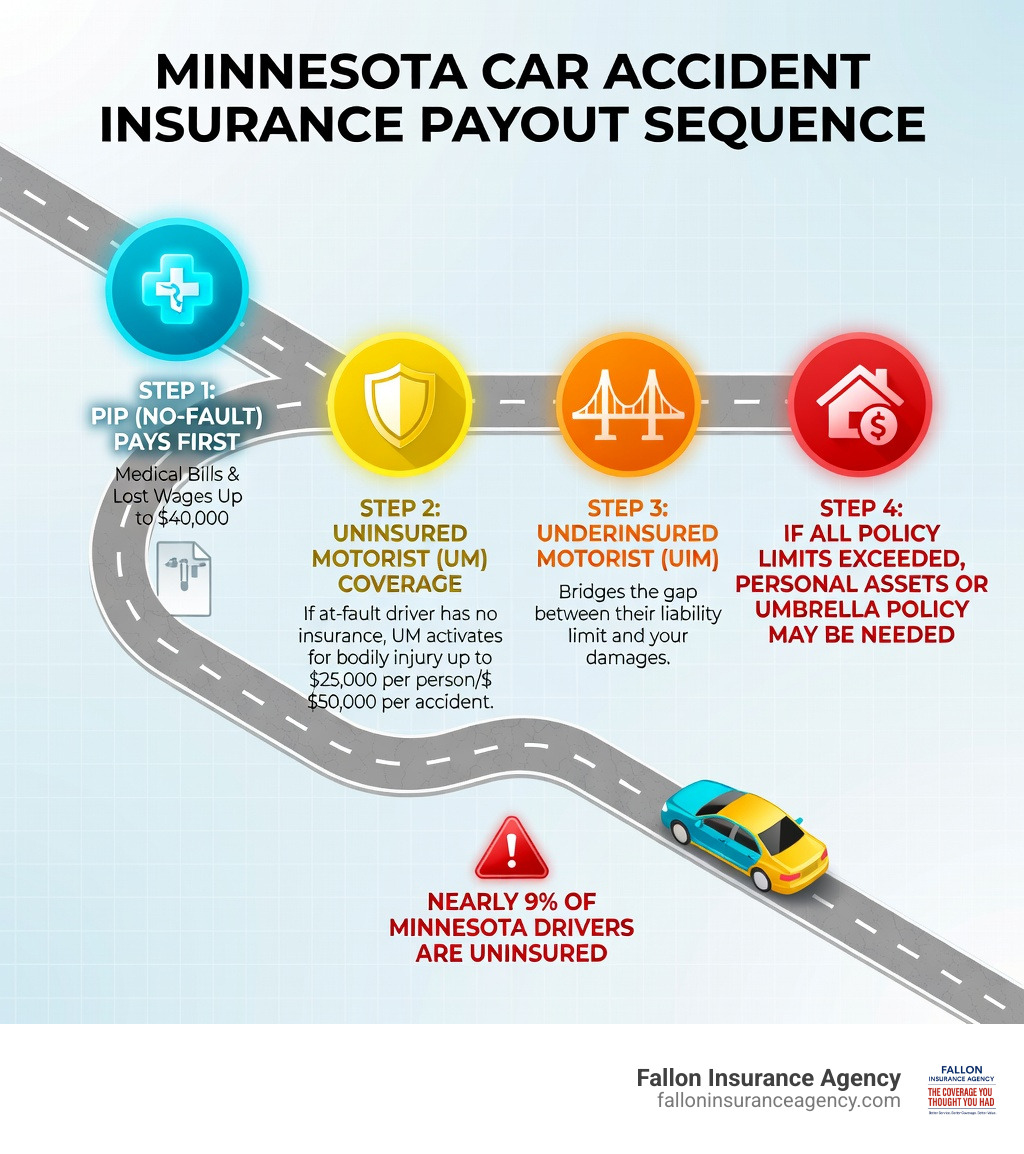
Minnesota is also a no-fault state, which means your own insurance pays first for injuries, regardless of who caused the crash. But no-fault benefits have limits. When those run out, UM coverage is what protects you next.
The problem most families don’t see coming? The minimums often aren’t enough. A serious accident — broken bones, a hospital stay, weeks off work — can easily exceed $25,000 in damages. If your UM limits are set to the state minimum, you absorb the rest out of pocket.
I’m Leland Fallon, founder of Fallon Insurance Agency. I’ve spent years helping Minnesota and Wisconsin families find out — before a claim, not after — whether their UM coverage would actually hold up when it matters most. In this guide, I’ll walk you through exactly how uninsured motorist coverage Minnesota drivers need works, what the law requires, and where most policies quietly fall short.
What is Uninsured Motorist Coverage in Minnesota?
Simply put, uninsured motorist coverage Minnesota (often called UM) is protection you buy for yourself and your family. While liability insurance protects your assets if you cause an accident, UM coverage protects your health and financial future when someone else causes an accident but hasn’t followed the law to carry insurance.
In Minnesota, we see accidents every day where the at-fault driver simply doesn’t have a valid policy. Maybe they let it lapse, or maybe they never had one to begin with. The latest data shows that nearly 10 percent of drivers in our state are operating without insurance. When one of these drivers causes a collision, they typically don’t have the personal assets to pay for your medical bills or pain and suffering.

UM coverage is a critical safety net because it also covers “hit-and-run” accidents and “phantom vehicles.” If a driver strikes you and flees, or if a driver causes you to crash but makes no physical contact and then disappears, your UM coverage steps in to act as the insurance the other driver should have had.
We often tell our clients in Minneapolis and Rochester that UM coverage isn’t just a legal checkbox. It is the only way to ensure that a stranger’s poor financial decisions don’t become your family’s financial ruin.
Defining an Uninsured Motor Vehicle Under State Law
What exactly counts as an “uninsured motor vehicle” in the eyes of the law? According to the MN Revisor’s Office, a vehicle is considered uninsured if:
- There is no insurance policy in effect at the time of the accident.
- The vehicle has insurance, but the limits are lower than the Minnesota state minimum requirements of $30,000 per person and $60,000 per accident for bodily injury.
- The insurance company for the at-fault driver denies coverage or has gone bankrupt.
- The vehicle is a hit-and-run or phantom vehicle where the owner or driver cannot be identified.
Understanding these legal definitions is vital. For example, if you are hit by a driver from a state with lower minimum requirements than ours, and their policy only provides $15,000 in coverage, Minnesota law treats them as an uninsured motorist for the purposes of your UM claim. This is part of how auto-insurance-minnesota is set up to protect residents from out-of-state drivers or those with “junk” policies.
Minimum uninsured motorist coverage Minnesota Requirements
Minnesota law is very clear: every owner of a motor vehicle registered or principally garaged in this state must maintain UM coverage. The legal minimums are:
- $25,000 for injuries to or the death of one person in any one accident.
- $50,000 for injuries to or the death of two or more persons in any one accident.
While these are the legal minimums, we rarely recommend them. Think about the cost of a modern ER visit, an MRI, physical therapy, and several weeks of lost income. It doesn’t take much for a bill to cross the $25,000 mark.
When we help families in Duluth or Bloomington navigating-auto-insurance, we look at their actual risks. If you have a mortgage, a retirement account, or children, a $25,000 limit is like using a cocktail umbrella to stop a Minnesota blizzard. We typically suggest matching your UM limits to your liability limits — often $100,000/$300,000 or higher — to ensure you are as well-protected as the people you might accidentally hit.
How the No-Fault System and UM Claims Work Together
Minnesota’s “No-Fault” system often confuses people. “No-Fault” does not mean that no one is at fault for the accident. Instead, it means that your own insurance company handles your immediate medical expenses and lost wages regardless of who caused the crash. This is called Personal Injury Protection, or PIP.
In Minnesota, your PIP coverage provides a minimum of $40,000 per person ($20,000 for medical expenses and $20,000 for non-medical expenses like lost wages or replacement services).
So, where does UM come in? Think of it as a relay race. Your PIP coverage runs the first lap. Once your medical bills exceed your PIP limits, or if you have permanent injuries, significant scarring, or disability, you can “step over” into a liability claim. If the person who caused those injuries has no insurance, your uninsured motorist coverage Minnesota policy takes over the race.
UM covers what PIP doesn’t: the full extent of your pain and suffering, emotional distress, and the medical bills that exceed that initial $20,000 medical PIP limit. This interaction is explained in detail in our auto-insurance-minneapolis-mn-guide.
Who Pays First? Priority Rules and Stacking
One of the most confusing parts of Minnesota insurance law is figuring out which policy pays first.
Generally, the rules are:
- If you are in a vehicle you own, your own policy is primary.
- If you are a passenger in someone else’s vehicle and you don’t own a car, the policy on that vehicle pays.
- If you are a passenger but you do own a car, you typically look to your own policy first for UM benefits.
Regarding “stacking” — the practice of adding together limits from multiple vehicles or policies — Minnesota has largely moved to an “anti-stacking” stance. Under Minn. Stat. § 65B.49, you generally cannot stack UM or UIM limits. This means if you have three cars insured with $50,000 in UM coverage each, you cannot claim $150,000. You are limited to the amount on the vehicle involved in the crash or the highest limit among your policies if you weren’t in your own car.
However, there is a concept of “excess” coverage. If you are injured while occupying a vehicle you don’t own, and that vehicle has lower UM limits than your personal policy, you might be able to claim the difference from your own insurer. This is a nuanced area of the law, much like the rules we discuss for our neighbors across the border in our guide on everything-you-need-to-know-about-wisconsin-car-insurance-coverage.
Eligibility and the Definition of “Occupying”
Who is covered under your UM policy? It’s not just you. In Minnesota, UM coverage generally extends to:
- The “Named Insured” (the person listed on the policy).
- Their spouse and any relatives living in the same household.
- Anyone else “occupying” the insured vehicle with permission.
The word “occupying” is a legal term. It doesn’t just mean sitting in the driver’s seat. Minnesota courts have defined it to include getting into, getting out of, or even being in immediate proximity to the vehicle while performing a task related to it (like changing a tire).
UM coverage also protects you as a pedestrian or a bicyclist. If you are walking your dog in Woodbury and an uninsured driver strikes you, your own auto insurance policy’s UM coverage will pay for your injuries. You don’t have to be inside a car to benefit from the protection you pay for every month. This is one of the many services we highlight when explaining the value of a robust policy.
Filing a Claim and Recovering Damages
If you’ve been hit by an uninsured driver, you need to act quickly. While Minnesota has a 6-year statute of limitations for most contract-based claims like UM, you shouldn’t wait. Memories fade, and evidence disappears.
To recover damages, you must prove:
- The other driver was at fault.
- The other driver was uninsured (or it was a hit-and-run).
- You suffered actual damages (injuries, lost wages, etc.).
We recommend our clients in minneapolis-minnesota take immediate action.
Steps to take:
- Call the police: A police report is the strongest piece of evidence for a UM claim.
- Document everything: Take photos of the damage, the location, and your injuries.
- Identify witnesses: If it was a hit-and-run, witnesses are often the only way to prove a “phantom vehicle” existed.
- Seek medical care: Even if you feel “fine,” adrenaline can mask serious injuries like whiplash or internal bruising.
- Notify us: You need to put your insurance company on notice that a UM claim is possible.
Through a UM claim, you can recover “economic damages” (medical bills, future medical costs, lost wages) and “non-economic damages” (pain and suffering, disability, emotional distress, and loss of consortium).
Common Exclusions and Limitations
Insurance policies are full of fine print, and UM coverage is no exception. We want our neighbors in st-paul-minnesota to be aware of common exclusions that could leave them stranded:
- Owned-but-uninsured exclusion: If you own a car but choose not to insure it, you cannot use the UM coverage from your other insured vehicles if you are injured while driving the uninsured one.
- Motorcycle exclusions: In Minnesota, PIP is not required for motorcycles, but UM and UIM are. However, the rules for how UM applies to a motorcycle accident can be different than a standard auto policy. Always check if your bike is properly covered.
- Intentional acts: If someone uses a vehicle as a weapon to intentionally hurt you, insurance often excludes this as it is considered a criminal act rather than an “accident.”
- Family member exclusions: Some policies try to limit coverage if the “uninsured” driver is a member of your own household (though Minnesota courts have placed strict limits on how these exclusions can be applied).
Frequently Asked Questions about uninsured motorist coverage Minnesota
Does UM coverage apply to hit-and-run accidents?
Yes, absolutely. This is one of the most common uses for UM coverage. In Minnesota, a “hit-and-run” or “phantom vehicle” is treated as an uninsured motorist.
However, there is a catch. To prevent fraud, insurance companies often require “corroboration” for phantom vehicle claims (where there was no physical contact). This usually means you need an independent witness or physical evidence (like skid marks or debris) to prove that another vehicle actually caused the accident. If you are hit by a driver who flees, try to get a license plate number, but never put yourself in danger to do so. A police report filed immediately is your best friend here.
What happens if my damages exceed the policy limits?
This is the “what if” scenario we talk about most at Fallon Insurance Agency. If you have the minimum $25,000 in UM coverage, but your medical bills and lost wages total $100,000, you are in a difficult spot.
You may be able to look toward Underinsured Motorist (UIM) coverage if the other driver had some insurance, but not enough. If they had no insurance, you are generally capped at your UM limit.
This is why we strongly advocate for two things:
- Higher UM/UIM Limits: It usually costs very little to move from a $25k limit to a $100k or $250k limit.
- Umbrella Insurance: A personal umbrella policy can provide an extra $1 million or more of liability protection. While most umbrellas only cover liability, some can be written to include “Excess UM/UIM” coverage. This is the ultimate safety net for your life savings. You can get-a-quote to see how affordable this extra layer of protection can be.
Do I need a lawyer for a UM claim?
Not every claim needs a lawyer, but UM claims can get complicated. When you file a UM claim, you are essentially suing your own insurance company. They “step into the shoes” of the uninsured driver. Their goal is to pay out as little as possible to protect their bottom line.
If your injuries are serious, if the insurer is disputing who was at fault, or if they are offering a settlement that doesn’t cover your bills, it is time to seek professional advice. A lawyer can help with claim valuation and ensure you aren’t being bullied into a lowball offer.
Conclusion
At Fallon Insurance Agency, we’ve seen the aftermath of accidents where the coverage looked fine on a piece of paper but failed in the real world. We don’t want you to be the family that discovers their $25,000 limit won’t cover a single week in the ICU.
Whether you are in Eagan, Lakeville, or Madison, our job is to help you understand what your policy actually does when things go wrong. We walk clients through real-life “what if” scenarios — like what happens if a family breadwinner is out of work for months after being hit by an uninsured driver, or if medical bills keep stacking up after PIP runs out.
Having enough uninsured motorist coverage Minnesota drivers need isn’t just about following the law. It’s about making sure your savings, your home, and your family’s day-to-day life aren’t put at risk by someone else’s bad decision to drive uninsured.
If you want a second set of eyes on your auto policy and UM/UIM limits, visit our auto-insurance page to learn more about building coverage that holds up when you actually need it most.

Leland Fallon
Leland Fallon is the founder of Fallon Insurance Agency, dedicated to protecting families across the Midwest. His mission is simple: make sure no family ever finds out they were underinsured after it’s too late. By uncovering hidden coverage gaps, he ensures his clients are fully protected not just carrying a policy.