



Why Your Insurance Check Might Be Lower Than You Think
When you’re standing in your driveway after a house fire or a major storm, the last thing you want is a surprise from your insurance company. The difference between actual cash value vs replacement cost is often the difference between being able to rebuild your home or being stuck with a bill you simply can’t pay. Most people don’t realize there’s a gap until they’re holding a check that doesn’t cover the repairs.
| Actual Cash Value (ACV) | Replacement Cost Value (RCV) | |
|---|---|---|
| What it pays | What your item is worth today | What it costs to replace it new |
| Depreciation | Yes — subtracted from payout | No — paid at current prices |
| Payout amount | Lower | Higher |
| Premium cost | Lower | Higher |
| Best for | Lower-value items | Primary homes and belongings |
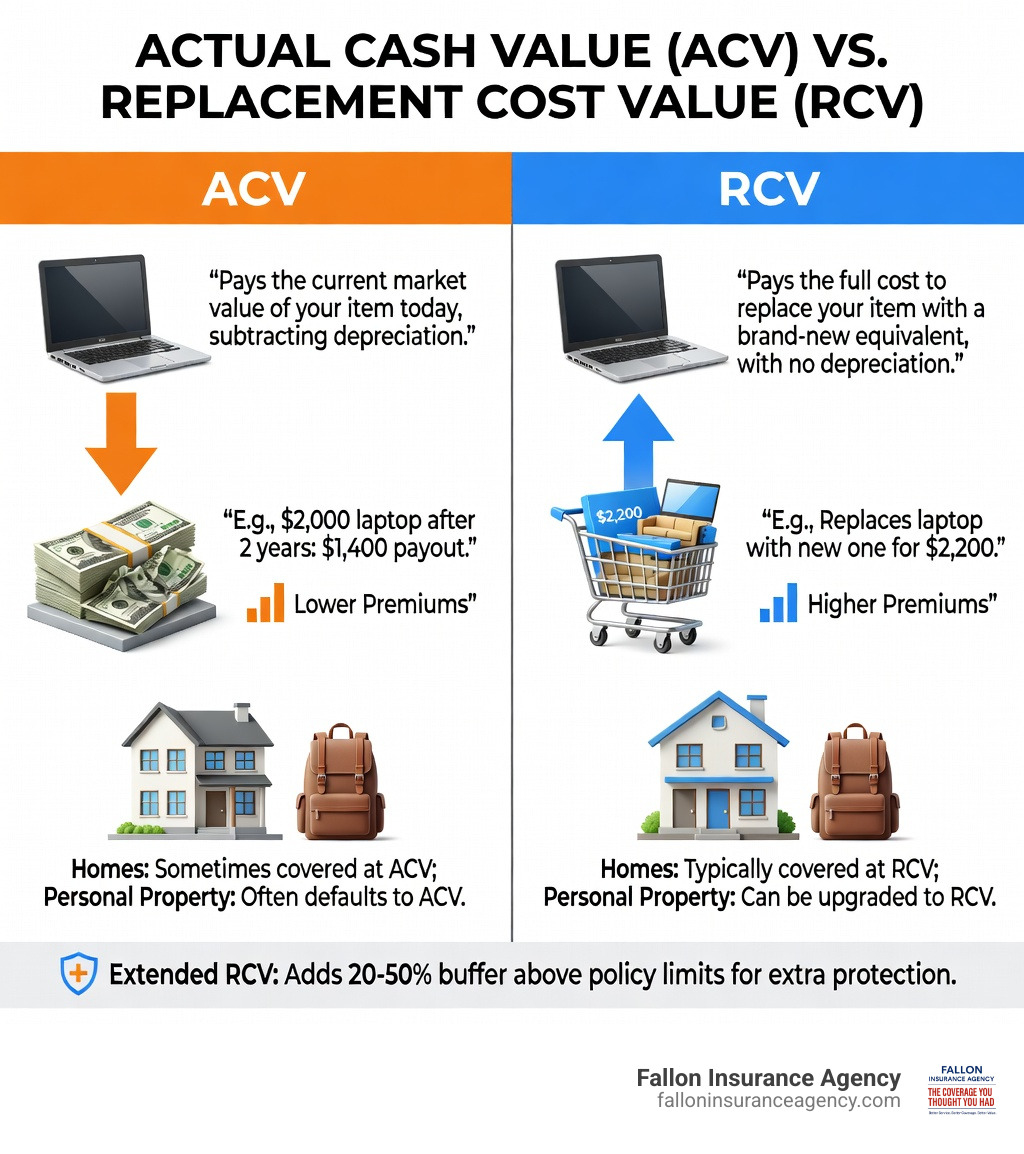
Many homeowners assume their policy will pay enough to replace everything they lost. They often find out too late that their coverage was only paying out the depreciated value. If a laptop you bought for $2,000 two years ago is stolen, an ACV policy might only give you $1,400. That $600 gap is money you have to find in your own savings.
I’m Leland Fallon. I started Fallon Insurance Agency because I saw too many people get checks that didn’t cover their losses. After years of reviewing coverage for families across Minnesota and Wisconsin, I’ve found that the actual cash value vs replacement issue is the most common reason people end up underinsured. If you aren’t sure which one you have, it’s worth checking now.
Actual Cash Value vs Replacement: How Your Stuff is Valued
When we talk to families in Hudson, WI, or Bloomington, MN, we start by looking at their declarations page. This is the summary of your policy, but it doesn’t always make the valuation method clear. Understanding actual cash value vs replacement is about knowing how an insurance company views your property.
In the insurance world, items lose value over time due to wear and tear. This is called depreciation. If you have an ACV policy, the insurance company pays you the “garage sale” value of your items. If you have an RCV policy, they pay you enough to go to the store and buy a brand-new version of what you lost.

Choosing between these two isn’t about saving a few dollars on your monthly premium. It’s about whether you have the cash to cover the gap if your house burns down tomorrow. While ACV policies are cheaper upfront, they leave you responsible for the difference between the old item’s value and the new item’s cost. We usually recommend RCV because insurance should get you back to where you were before the loss, not just give you a fraction of what it costs to start over.
How Depreciation Affects Your Claim
Depreciation is the reason an ACV claim payout can feel surprisingly small. Insurers calculate how much “life” an item has left to determine its value.
Consider these examples:
- The Television: You bought a $3,000 TV five years ago. If the insurance company decides its useful life is 10 years, it has lost 50% of its value. If a comparable new TV costs $3,500 today, an ACV payout would be $1,750.
- The Laptop: Technology loses value quickly. A $2,000 laptop from two years ago might only be valued at $1,400 under ACV.
- The Couch: A $2,000 couch bought four years ago might only pay out $1,200 after factoring in wear and tear.
This is most critical when it comes to your roof. In Minnesota and Wisconsin, hail damage is common. If you have an ACV policy on your roof and a storm hits when the shingles are 15 years old, the insurance company might only pay for 25% of the replacement cost. You could be stuck paying $15,000 or more out of pocket just to get a new roof. This is why we tell our clients to check if their roof is covered at RCV or ACV.
How a Replacement Cost Claim Works
One thing that surprises homeowners in places like Eagan, MN, or Eau Claire, WI, is that even with an RCV policy, you don’t always get the full amount in one check. It usually happens in two steps.
- The First Check (ACV): When you file the claim, the adjuster calculates the Actual Cash Value. They issue a check for that amount, minus your deductible. This is the amount they owe you regardless of whether you replace the item.
- The Second Check (Recoverable Depreciation): Once you actually buy the new item or hire the contractor to finish the repairs, you submit the receipts to the insurance company. They then reimburse you for the difference between the first check and what you actually spent.
If you choose not to replace the item, you keep the first check. But to get the full replacement value, you have to prove you spent the money. This can create a cash flow issue, as you may need to use savings to bridge the gap until the second check arrives.
What Happens When Rebuilding Costs Spike
Even a good Replacement Cost policy can leave you short if construction costs surge. If a major storm hits the Twin Cities or Milwaukee, the price of lumber and labor often spikes because every contractor is suddenly in high demand. Your $300,000 policy limit might have been accurate last year, but it could cost $375,000 to rebuild that same house today.
This is where Extended Replacement Cost and Guaranteed Replacement Cost matter.
- Extended Replacement Cost: This adds a buffer to your dwelling coverage, typically 20% to 50%. If you have a $300,000 policy with a 20% extension, the company will pay up to $360,000 to rebuild your home if costs surge.
- Guaranteed Replacement Cost: This pays to rebuild your home exactly as it was, regardless of the cost or your policy limits. It is the strongest protection against inflation and price spikes after a disaster.
These options don’t cost much more, but they can save you tens of thousands of dollars if construction costs rise unexpectedly in your area. It’s about making sure your protection keeps up with the real world.
Common Questions
Does my policy cover my belongings at actual cash value or replacement?
In many standard policies, the house itself is covered at Replacement Cost, but your personal property-like clothes, furniture, and electronics-defaults to Actual Cash Value. This is a common gap. You might have enough coverage to rebuild the house, but not enough to replace the things inside it.
Check your declarations page for terms like “Replacement Cost Contents” or “Personal Property Replacement Cost.” If you don’t see them, you likely have ACV. For residents in the suburbs, like Maple Grove, we recommend checking this specifically, as the cost to upgrade to RCV for your belongings usually doesn’t add much to your bill.
How do I know what my stuff is worth?
You can estimate ACV by taking the current price of an item and subtracting a percentage for every year you’ve owned it. The best way to prepare is to keep a home inventory. Take photos of your rooms, save digital receipts for expensive items, and log serial numbers. You can find helpful tips on creating a home inventory from the Insurance Information Institute. Having this documentation ready makes the process much easier if you ever have to file a claim.
How does this apply to auto and renters insurance?
Auto Insurance: Most standard auto policies are ACV. If you total your car, the insurer pays what the car was worth the second before the crash-not what you paid for it. This is why “Gap Insurance” is important for newer vehicles.
Renters Insurance: Renters policies often default to ACV. Since renters insurance is cheap anyway, upgrading to RCV is usually a smart move. It’s the difference between getting $200 for a five-year-old laptop or $1,500 for a new one.
Conclusion
At Fallon Insurance Agency, I want you to know exactly what your policy does before you ever have to file a claim. I have seen too many families in Minnesota and Wisconsin find out too late that their coverage was built for the lowest price rather than the actual cost of a loss.
The choice between actual cash value vs replacement comes down to this: do you want the policy to pay what your stuff is worth used, or what it costs to replace it new? That difference becomes very real after a house fire, a break-in, or a hail storm.
If you aren’t sure how your home, roof, or belongings are valued, let’s look at it together. We can review your policy and walk through real examples so there are no surprises later.
Contact Fallon Insurance Agency for a coverage review through our website: https://falloninsuranceagency.com/
Manual review has been completed: y

Leland Fallon
Leland Fallon is the founder of Fallon Insurance Agency, dedicated to protecting families across the Midwest. His mission is simple: make sure no family ever finds out they were underinsured after it’s too late. By uncovering hidden coverage gaps, he ensures his clients are fully protected not just carrying a policy.