


Introduction
When Following the Law Costs More Than Your Policy Covers
Ordinance or law coverage cost is something most homeowners never think about — until they’re staring at a repair bill that’s far bigger than their insurance payout.
Here is the quick answer:
| Coverage Detail | Typical Amount |
|---|---|
| Standard ordinance or law coverage included | ~10% of dwelling limit |
| Example: $350,000 home | Up to $35,000 included |
| Common flat dollar limit in some policies | ~$10,000 |
| Cost to add higher limits (25%-50%) | Small annual premium increase |
| How much code compliance can add to a claim | 50% or more of total claim cost |
If your home is insured for $350,000, you might only have $35,000 set aside for mandatory code upgrades—even though those upgrades could cost far more after a serious loss.
Here is why that matters: standard homeowners insurance is designed to restore your home to the way it was before the damage. It is not designed to pay for what local building codes now require your home to be. That gap — between what your policy covers and what the law demands — can run into tens of thousands of dollars out of your own pocket.
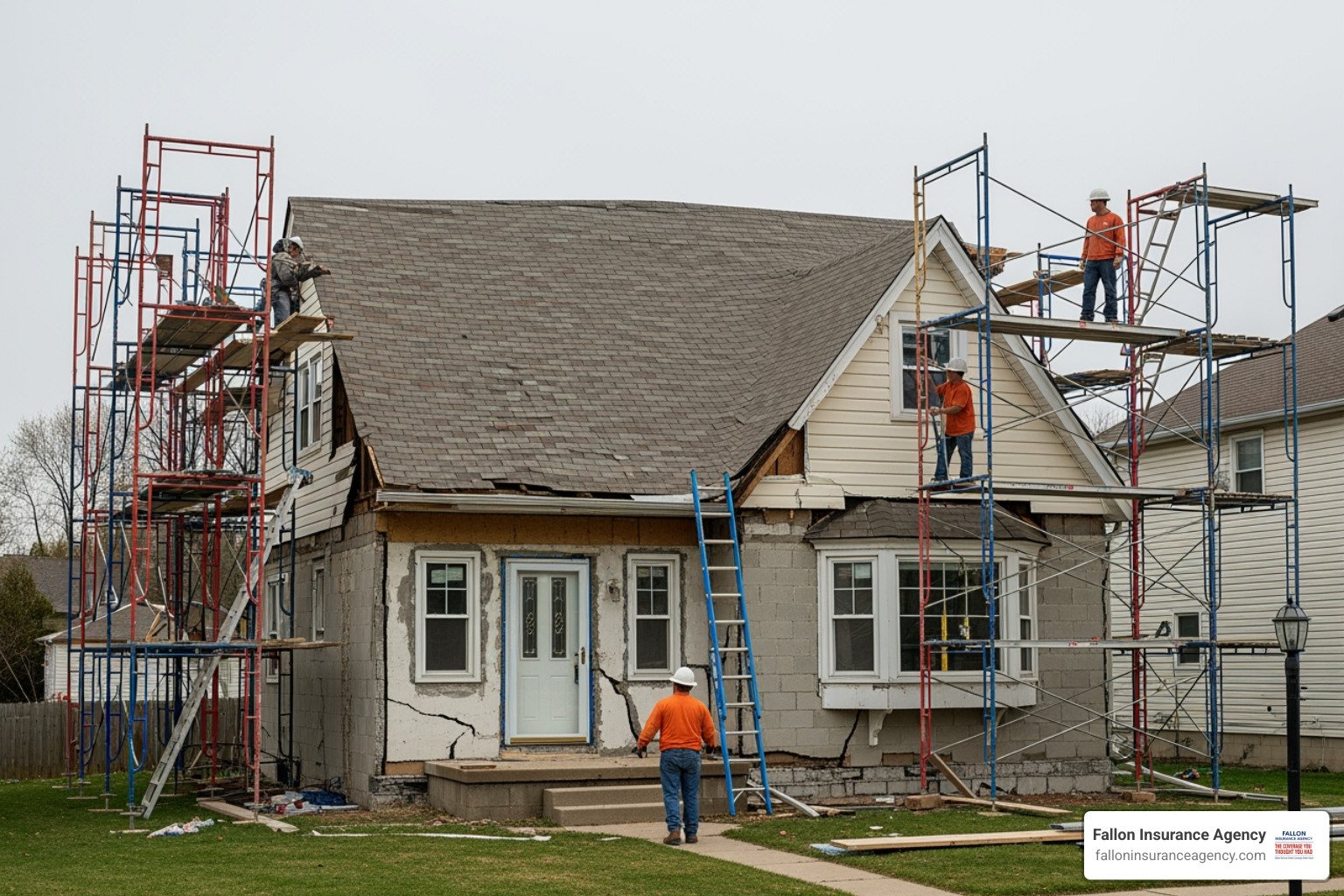
This is especially true for older homes in Minnesota and Wisconsin, where a partial fire, storm, or water loss can quickly trigger mandatory code upgrades across the entire structure — not just the damaged area.
I’m Leland Fallon, founder of Fallon Insurance Agency, and I’ve seen how ordinance or law coverage cost catches Midwest homeowners completely off guard when a real claim hits. This guide explains exactly what this coverage does, what it costs, and how to make sure you’re not left holding the bill.
Understanding the Three Parts of Ordinance or Law Coverage
When we talk about What Is Ordinance or Law Coverage for Homeowners?, we are looking at a safety net that fills the massive hole left by standard “Replacement Cost” coverage. Most people assume “Replacement Cost” means the insurance company builds them a brand-new house to modern standards.
In reality, standard policies only promise to replace what you had with “like kind and quality.” If you had 1970s-style ungrounded wiring, the insurance company technically only owes you for 1970s-style wiring. But the city inspector in Minneapolis or Milwaukee isn’t going to let you put that back in. They will demand modern, code-compliant electrical systems. This is where the ultimate-guide-to-home-insurance becomes essential reading.
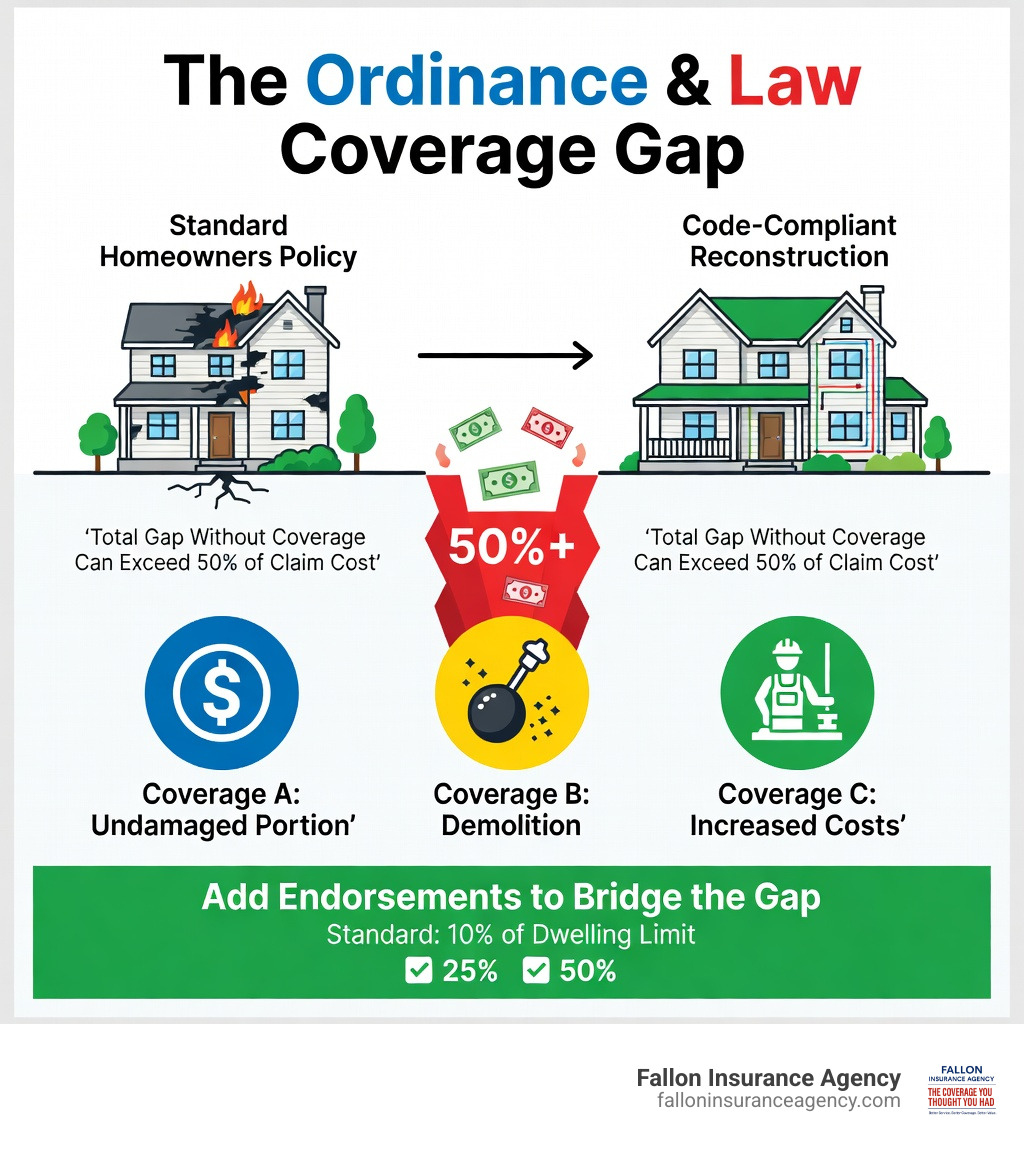
Ordinance or law coverage is actually split into three distinct “buckets” of protection:
Coverage A: Loss to the Undamaged Portion
This is the part that scares people the most. Imagine a fire destroys 60% of your home. In many Minnesota and Wisconsin municipalities, if a home is damaged beyond a certain threshold (often 50%), you aren’t allowed to just fix the broken part. The local government may require you to tear down the entire thing and start over.
Coverage A pays for the value of the 40% of the house that was perfectly fine but now has to be demolished because the law says so. Without this, your insurance company might only pay for the 60% that burned, leaving you to pay for the “undamaged” portion out of your own pocket.
Coverage B and C: Demolition and Increased Construction
Once the city orders that teardown, you have to pay to get rid of the debris. Coverage B covers the cost to demolish the undamaged part of the structure and haul it away.
Coverage C is the “Increased Cost of Construction.” This is the money that pays for the mandatory upgrades required by current building codes. When you rebuild, you aren’t just putting back what was there; you are installing:
- Modern HVAC systems with higher efficiency ratings.
- Updated electrical panels and wiring (no more knob and tube).
- Hardwired smoke detectors and fire suppression sprinklers.
- PEX or copper plumbing instead of outdated lead or galvanized pipes.
- Accessibility features like wider hallways or ramps if required by local ordinances.
- Energy-efficient windows and insulation that meet current “Green” building standards.
Factors Influencing Your Ordinance or Law Coverage Cost

Many of our clients ask why their ordinance or law coverage cost varies so much from their neighbor’s. The truth is, insurance companies look at the specific risk of your home being “out of code.” If you live in a brand-new build in Woodbury, MN, or a recent development in Eagan, your home likely meets all current standards. Your risk is low.
However, if you own a beautiful historic home in Saint Paul or a classic bungalow in Milwaukee, the gap between your current home and modern building codes is a canyon. This is one of the major risks-of-check-the-box-home-insurance, where a standard 10% limit simply won’t cut it.
| Coverage Level | Estimated Annual Cost Impact | Best For |
|---|---|---|
| 10% (Standard) | Included in base premium | Homes built in the last 10-15 years |
| 25% Endorsement | $20 – $50 extra per year | Homes 20-40 years old |
| 50% Endorsement | $50 – $100+ extra per year | Historic homes or homes in high-risk zones |
How Home Age Impacts Your Ordinance or Law Coverage Cost
The older the home, the higher the potential for a massive ordinance claim. If your home still has remnants of knob and tube wiring or ungrounded electrical systems, a small kitchen fire could lead to a “discovery” by an inspector. Once they see the outdated wiring, they may mandate that the entire house be rewired to meet the Building Codes Fact Sheet standards.
In older Midwest neighborhoods, we see this frequently with plumbing and insulation. Modern codes require specific R-values for insulation that old balloon-frame houses simply don’t have. Adding that insulation during a repair isn’t just a “nice to have”—it’s a legal requirement that adds thousands to the bill.
Calculating the Ordinance or Law Coverage Cost for Higher Limits
The good news is that increasing your limit is surprisingly affordable. When you look at your home-insurance quote, you’ll see that jumping from a 10% limit to a 50% limit often costs less than a single dinner out.
For a home with a $400,000 dwelling limit:
- 10% gives you $40,000.
- 50% gives you $200,000.
In a scenario where a major storm hits Rochester or Duluth and triggers a total rebuild, having that extra $160,000 in coverage for just a few extra dollars a month is the difference between keeping your home and facing financial ruin.
Why the “50% Rule” Makes This Coverage Essential
In many parts of Minnesota and Wisconsin, local ordinances include what we call the “50% Rule.” This law states that if a building is damaged by more than 50% of its value (sometimes 60% depending on the city), it cannot be repaired. It must be demolished and rebuilt from the ground up to satisfy every single modern building code on the books.
This creates a “hidden total loss.” Your eyes see a house that is half-standing. Your insurance adjuster sees a “partial loss” based on the fire damage. But the City of Madison or the City of Bloomington sees a structure that must be leveled.
If you don’t have adequate ordinance or law coverage, you are stuck in a nightmare:
- The insurance company pays for the 50% fire damage.
- The city orders you to demolish the remaining 50%.
- You have to pay for the demolition yourself.
- You have to pay to rebuild that second 50% yourself.
- You have to pay for all the modern upgrades (sprinklers, wiring, etc.) yourself.
This is exactly why-standard-roof-coverage-is-not-enough and why we emphasize looking at the “what if” scenarios. Compliance with these laws after a loss can easily add 50% or more to the total cost of a claim.
Frequently Asked Questions about Code Compliance Insurance
Is ordinance or law coverage included in a standard policy?
Yes, most standard homeowners policies in the Midwest include a “built-in” amount, typically 10% of your dwelling coverage. However, some “budget” policies might cap this at a flat $10,000. While $10,000 sounds like a lot, it disappears instantly when you’re talking about a full rewiring or a whole-house HVAC upgrade. For newer homes (0-10 years old), some specialized providers might include up to $30,000, but you should always verify this with your agent.
Does this coverage pay for pre-existing code violations?
No. This is a common misunderstanding. If you know your basement was finished without a permit and doesn’t meet egress window codes, you can’t use this insurance to “fix” it on a sunny Tuesday. The coverage is only triggered when a covered loss (like a fire or windstorm) happens first. Furthermore, it generally excludes losses resulting from prior non-compliance that you were already ordered to fix.
How much extra coverage should a Minnesota or Wisconsin homeowner buy?
If your home was built before 1980, we almost always recommend increasing your limit to 25% or 50%. The ordinance or law coverage cost to do so is minimal compared to the risk. We suggest a professional assessment of your home’s age and a quick check of your local city’s “substantial damage” ordinances. If you live in a historic district like those in Saint Paul or Milwaukee, the requirements are even stricter and the costs are even higher.
Conclusion: Protecting Your Home Against Regulatory Surprises
At Fallon Insurance Agency, we try to keep people out of “check-the-box” coverage that looks fine until a real claim happens. If you live anywhere in Minnesota or Wisconsin, building codes can turn a straightforward repair into a much bigger (and more expensive) rebuild.
The ordinance or law coverage cost is usually small compared to what code upgrades can cost after a fire, storm, or major water loss. The time to fix the gap is before you need it.
If you want help reviewing your dwelling limit and your ordinance or law limit, reach out to Fallon Insurance Agency. We can walk through a couple realistic “what if” scenarios so you know exactly what would happen on claim day.
For more local guidance, you can also read our home-insurance-in-minnesota-a-comprehensive-guide-to-smarter-protection or find more info about Minnesota home insurance on our site.

Leland Fallon
Leland Fallon is the founder of Fallon Insurance Agency, dedicated to protecting families across the Midwest. His mission is simple: make sure no family ever finds out they were underinsured after it’s too late. By uncovering hidden coverage gaps, he ensures his clients are fully protected not just carrying a policy.