



Home Insurance in Minneapolis, MN: What You Need to Know Before You Buy
Home insurance Minneapolis MN costs more than almost anywhere else in the state — and most homeowners don’t find out why until after something goes wrong.
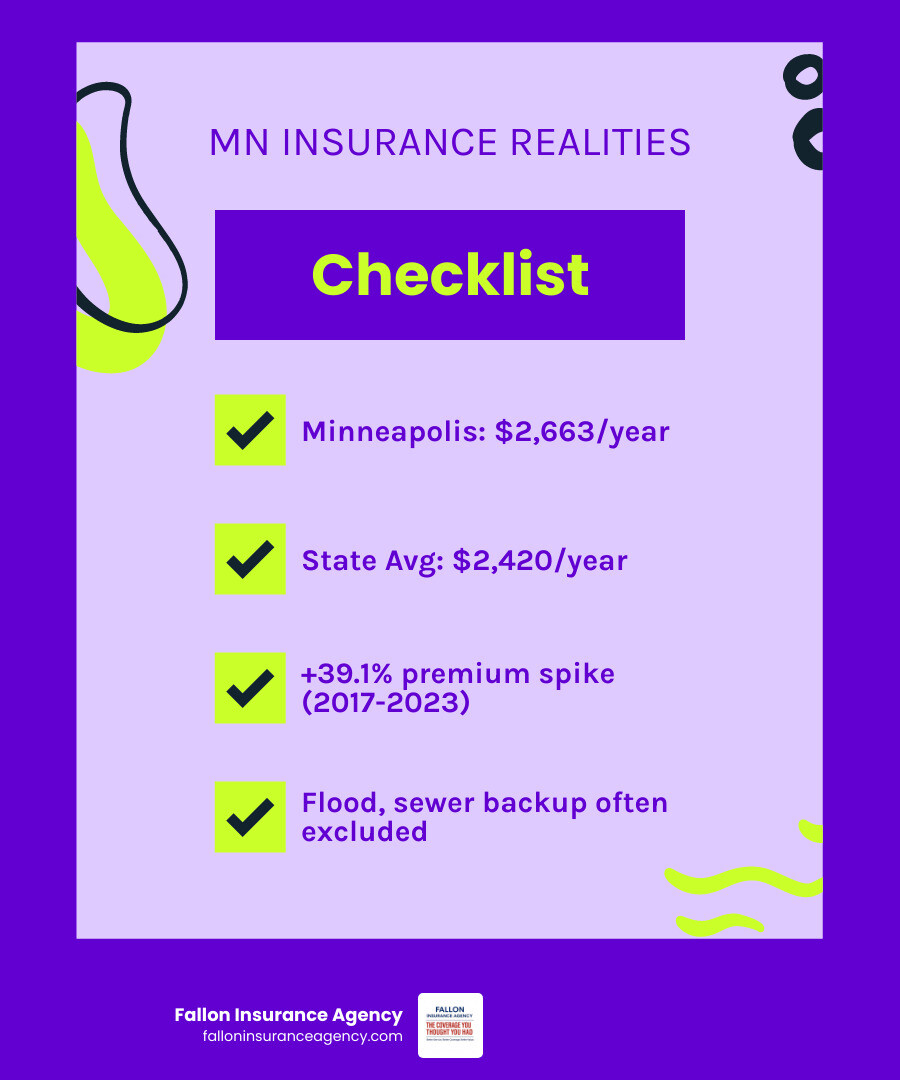
Here’s a quick snapshot of what Minneapolis homeowners are dealing with right now:
| Minneapolis | State Average | National Average | |
|---|---|---|---|
| Average annual premium | $2,663 | $2,420 | $2,601 |
| Average monthly cost | $222 | $202 | $217 |
| Coverage basis | $300K dwelling | $300K dwelling | $300K dwelling |
| Premium increase (2017-2023) | +39.1% | +39.1% | Lower |
A few things stand out:
- Minneapolis has the highest average home insurance rates among major Minnesota cities
- Premiums have jumped nearly 40% in six years — outpacing most of the country
- Standard policies often don’t cover flood damage, sewer backup, or full rebuilding costs after a major loss
If you’re shopping for coverage right now, the most important thing to understand is this: the cheapest policy is rarely the right one. A house fire, a burst pipe in January, or a slip-and-fall lawsuit can expose gaps that a low-premium policy was never built to handle.
I’m Leland Fallon, founder of Fallon Insurance Agency — I’ve spent years reviewing home insurance Minneapolis MN policies and seeing how many families are quietly underinsured without realizing it. This guide will walk you through what coverage actually costs here, what it should include, and how to avoid the gaps that cause real financial harm when a claim happens.
Why Home Insurance Minneapolis MN Costs More Than Other Cities

When you look at the numbers, it’s clear that living in the “City of Lakes” comes with a higher insurance price tag. At an average of $2,663 annually, Minneapolis residents pay significantly more than their neighbors in St. Paul or Rochester.
But why is that? It isn’t just one thing; it’s a combination of urban risks that insurance carriers track closely. First, property density is a major factor. In a city like Minneapolis, houses are closer together. If a neighbor’s house catches fire, there is a much higher statistical chance that the heat or flames will damage your property too.
Second, urban crime rates for theft and vandalism are generally higher in major metropolitan centers than in rural areas. While we love our city, insurance companies see these statistics as an increased likelihood of a claim. Finally, the sheer value of the real estate and the cost of labor in the Twin Cities drive up the “replacement cost” of a home.
One of the most jarring statistics for our clients is the 39.1% spike in premiums seen between 2017 and 2023. This increase is driven by extreme weather events and a massive rise in construction costs. If you feel like your bill is creeping up every year, you are right. You can find out more about how your specific bill stacks up by checking if Is Your MN Home Insurance Premium Above Average?.
Factors Affecting Home Insurance Minneapolis MN Rates
Beyond just your ZIP code, several personal and property-specific factors determine what you pay.
- Home Age: Minneapolis is full of beautiful, historic homes. However, older homes often have outdated electrical, plumbing, and heating systems. A pre-war home with knob-and-tube wiring is a much higher fire risk than a new build in Woodbury or Eagan.
- Construction Materials: Is your home brick, stone, or wood frame? Brick homes typically have lower premiums because they are more fire-resistant.
- Credit Score: In Minnesota, insurance companies are allowed to use your credit-based insurance score to help determine your rate. A higher score typically leads to lower premiums because insurers view it as a sign of financial stability.
- Fire Protection: How close is your home to a fire hydrant and a fire station? In Minneapolis, this is rarely an issue, but it’s a huge factor in more rural parts of the state.
At Fallon Insurance Agency, we often warn against the Risks of ‘Check the Box’ Home Insurance. It’s easy to go online and just click the cheapest option, but that often ignores these critical factors, leaving you with a policy that doesn’t actually fit the reality of your 1920s bungalow.
Comparing Home Insurance Minneapolis MN to Duluth and Rochester
It is helpful to see how Minneapolis compares to other major hubs where we serve clients, like Duluth and Rochester.
| City | Average Annual Premium | Difference from Mpls |
|---|---|---|
| Minneapolis | $2,663 | – |
| Rochester | $2,254 | -$409 |
| Duluth | ~$2,350 | -$313 |
| State Average | $2,420 | -$243 |
Rochester tends to be the most affordable of the three, largely due to lower urban density and different weather patterns. Duluth homeowners face their own unique challenges, specifically the “lake effect” weather that can bring massive snow loads and high winds off Lake Superior. However, Minneapolis remains the “king of costs” because of the urban factors mentioned earlier. Whether you are in Bloomington or Lakeville, your rates will likely be closer to the state average, but once you cross into Minneapolis city limits, expect that urban surcharge.
Beyond the Basics: Coverage Minneapolis Residents Actually Need
Most people think their home insurance Minneapolis MN policy covers “everything.” Unfortunately, that’s a dangerous assumption. A standard policy (often called an HO-3) covers fire, wind, hail, and theft. But in Minnesota, some of our biggest risks aren’t included in the base price.
Take water damage, for example. If a pipe bursts in your wall, you’re usually covered. But what if the city sewer line backs up into your basement? Or what if your sump pump fails during a massive summer downpour? Standard policies usually exclude “Sewer Backup” and “Sump Pump Failure” unless you specifically add an endorsement for them. In older Minneapolis neighborhoods with aging infrastructure, this is a “must-have” coverage.
Then there is the issue of flooding. Many people don’t realize that surface water—water that comes from the ground up into your home—is never covered by a standard policy. If the Mississippi River rises or a heavy rainstorm creates a lake in your yard that seeps into your foundation, you need a separate policy through the National Flood Insurance Program.
We also see many homeowners get burned on roof claims. As rates have risen, many companies have moved toward “Actual Cash Value” (ACV) for roofs rather than “Replacement Cost.” This means if your 15-year-old roof is destroyed by hail, the insurance company will subtract years of depreciation from your check. You might only get half of what it costs to actually put a new roof on. This is why we tell our clients that Why Standard Roof Coverage Is Not Enough.
Liability and Umbrella Protection
One of the most overlooked parts of home insurance Minneapolis MN is the liability section. This is the part of your policy that pays out if you are sued because someone got hurt on your property—or even off your property in some cases.
Think about these “what-if” scenarios:
- Your dog, usually a “good boy,” gets spooked and bites a neighbor.
- A delivery driver slips on an icy patch on your sidewalk that you didn’t have time to salt.
- Your teenager accidentally causes a major accident while driving (if you have bundled policies).
In today’s world, a $300,000 liability limit can be wiped out in a single serious medical claim or lawsuit. If you have assets to protect—like a home, savings, or a business—we strongly recommend looking into an Umbrella policy. This provides an extra $1 million or more of protection that kicks in after your home policy is exhausted. It’s surprisingly affordable and is a core part of our Ultimate Guide to Home Insurance.
Managing the Impact of Severe Weather and Rising Rates
Minnesota ranks 11th in the country for property and casualty losses. That is a staggering statistic for a state that doesn’t have hurricanes or major earthquakes. Our “hurricanes” come in the form of hailstorms and “blue sky” wind events.
Since 1980, Minnesota has experienced 62 weather disasters that caused more than $1 billion in damage each. Severe storms are the primary culprit. When a hailstorm rolls through the Twin Cities, it can damage tens of thousands of roofs in a single afternoon. Insurance companies have lost money in Minnesota almost every year since 2017, which is why they are raising rates and narrowing coverage.
Winter brings its own set of problems. Ice dams are a classic Minneapolis headache. When heat leaks from your attic, melts the snow on your roof, and then freezes at the gutters, it creates a dam that forces water under your shingles and into your bedroom ceiling. While insurance often covers the resulting water damage, they won’t pay to remove the ice dam itself or fix the insulation issue that caused it.
The Role of the Minnesota FAIR Plan
Sometimes, a property has had too many claims, or it’s in such a state of disrepair that no private insurance company will touch it. This is where the Minnesota FAIR Plan comes in.
The FAIR Plan is the “insurer of last resort.” It provides basic coverage for 3,690 high-risk properties that cannot get insurance elsewhere. However, there is a catch: the premiums are usually much higher, and the coverage is much more limited than what you’d get from a standard carrier. It’s a safety net, but our goal at Fallon Insurance Agency is always to help you find a way to qualify for standard coverage first.
Smart Ways to Lower Your Premiums Without Cutting Protection
With rates rising, everyone wants to save money. But there is a right way and a wrong way to do it. The wrong way is lowering your coverage limits or dropping necessary endorsements like sewer backup. The right way is using discounts that insurance companies already offer.
- Bundling: This is the single most effective way to save. Putting your home and auto insurance with the same company can often save you 15% to 25% on both policies. We’ve written extensively about How to Save Big with Homeowners and Auto Insurance Quotes because it truly is the “low-hanging fruit” of insurance savings.
- Security Systems: A professionally monitored burglar and fire alarm doesn’t just keep you safe; it can shave a few percentage points off your premium.
- Higher Deductibles: If you have a healthy emergency fund, consider raising your deductible from $1,000 to $2,500 or even $5,000. This lowers your annual premium significantly. Just remember, you’ll have to pay that amount out of pocket if you have a claim.
- Claim-Free History: Insurance companies love “boring” clients. If you haven’t filed a claim in five or ten years, you are eligible for some of the best rates available.
Frequently Asked Questions about Home Insurance Minneapolis MN
What is the average cost of home insurance Minneapolis MN?
The average cost is approximately $2,663 annually, which breaks down to about $222 per month. This is based on a home with $300,000 in dwelling coverage. That Minneapolis has the highest rates in the state due to urban density, older housing stock, and crime statistics.
Why are rates rising so fast in Minnesota?
Rates have spiked about 39% recently due to two main factors: extreme weather and construction costs. Minnesota has seen a massive increase in billion-dollar weather disasters (hail and wind). At the same time, the cost of lumber, roofing materials, and skilled labor has skyrocketed, meaning it costs the insurance company much more to rebuild your home today than it did five years ago.
Does standard insurance cover flood damage?
No. This is a common and costly misconception. Standard homeowners insurance excludes damage from “surface water” or flooding. If you live near a body of water or even at the bottom of a hill where water collects, you should look into a separate flood policy through the NFIP or a private flood insurer.
Conclusion
At Fallon Insurance Agency, we believe that insurance should be about more than just a monthly bill. It should be about peace of mind. We built this agency because we saw too many people in Minneapolis, St. Paul, and across the Midwest who had policies that “looked fine” on paper but were actually full of holes.
We don’t believe in selling minimum coverage just to hit a price point. Instead, we walk our clients through real-life “what-if” scenarios. What if a hailstorm hits? What if your basement floods? What if you’re sued? Our goal is to make sure that if something goes wrong tomorrow, your family is fully protected with no surprises.
If you’re ready for a different kind of insurance experience—one that prioritizes protection and honesty—we’re here to help. Whether you’re in Cannon Falls, Eau Claire, or right here in the Twin Cities, let’s make sure your Minnesota Home Insurance is actually doing its job. Reach out to us today, and let’s start a conversation about protecting what matters most.

Leland Fallon
Leland Fallon is the founder of Fallon Insurance Agency, dedicated to protecting families across the Midwest. His mission is simple: make sure no family ever finds out they were underinsured after it’s too late. By uncovering hidden coverage gaps, he ensures his clients are fully protected not just carrying a policy.