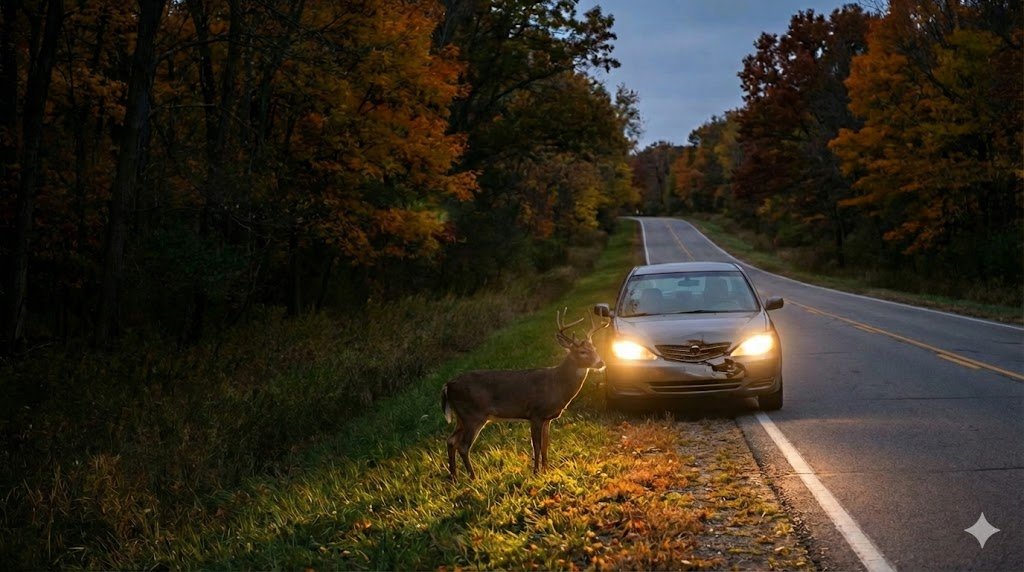
As the rut begins in Minnesota and Wisconsin, the risk of animal collisions spikes. Do you know if your policy actually covers the damage? The answer isn’t as simple as “I have full coverage.”
If you live in Minnesota, Wisconsin, or Iowa, you know the drill. It’s late October or early November. The crops are coming down, the days are getting shorter, and the roads are becoming a gauntlet. You scan the ditches constantly. You see the shine of eyes in your headlights. You know that at any moment, a 150-pound whitetail buck could spring from the cornstalks and total your vehicle.
It is a statistical reality of life in the Upper Midwest. Recent data shows that drivers in Wisconsin have roughly a 1 in 58 chance of hitting a deer this year. In Minnesota, the odds are similar at roughly 1 in 61.
We often treat these near-misses as stories to tell at the gas station or the office the next morning. But when your luck runs out—and for thousands of drivers every year, it does—the conversation shifts from “Did you see that buck?” to “Who is going to pay for this?”
At Fallon Insurance Agency, we see the aftermath of these collisions every single autumn. We see the smashed radiators, the shattered windshields, and the confused drivers who thought they were “fully covered” only to find out they were wrong.
This is your no-nonsense guide to surviving deer season—physically and financially.
The “Full Coverage” Myth
Let’s start by destroying a dangerous term: “Full Coverage.”
There is no line item on an insurance policy called “Full Coverage.” It is a shorthand term people use to mean they have more than just Liability insurance. But “more” doesn’t mean “everything.”
When you hit a deer, your Liability coverage (which pays for damage you do to others) does absolutely nothing for your car. To get your hood, bumper, and radiator fixed, you need Comprehensive Coverage.
Comprehensive vs. Collision: The Critical Distinction
Many drivers confuse these two, and in deer season, the difference is everything.
Collision Coverage: This pays for damage to your car if you hit another vehicle or a stationary object (like a tree, a guardrail, or a mailbox).
Comprehensive Coverage: This pays for damage caused by events “other than collision.” This includes fire, theft, vandalism, hail, and—crucially—contact with an animal.
If you dropped Comprehensive coverage on your older truck to save a few dollars a month, you are self-insuring that vehicle against deer. If you hit a buck tonight, the repair bill is 100% on you.
The “Swerve” Paradox: Why Your Instinct is Wrong?
This is the most important section of this article. Please read it twice.
When a deer leaps onto Highway 52 or I-94, your biological instinct is to swerve. You want to avoid the impact. Insurance-wise and safety-wise, swerving is often the worst decision you can make.
Here is the cold, hard reality of insurance logic:
Scenario A: You hit the deer.
The Claim: This is a Comprehensive claim.
The Fault: It is generally considered a “not-at-fault” accident. You cannot control nature.
The Deductible: You pay your Comprehensive deductible (often lower, like $250 or $500).
The Rate Impact: In many cases, a Comprehensive claim does not cause your insurance rates to skyrocket, because it’s not a reflection of your driving ability.
Scenario B: You swerve to miss the deer and hit a tree/ditch.
The Claim: This is now a Collision claim.
The Fault: You didn’t hit the animal; you lost control of your vehicle and hit a tree. That is an “at-fault” accident.
The Deductible: You pay your Collision deductible (often higher, like $500 or $1,000).
The Rate Impact: Because this is an at-fault accident, your premiums are highly likely to increase for the next 3-5 years.
The Physics: Beyond insurance, swerving is deadly. A deer is soft compared to a 100-year-old oak tree or an oncoming semi-truck. The vast majority of serious injuries and fatalities in “deer accidents” actually happen because the driver swerved, rolled the vehicle, or hit oncoming traffic.
The Rule: Brake firmly. Stay in your lane. If you have to hit it, hit it. It sounds brutal, but your car is replaceable. Your life (and your clean driving record) is worth more than the front bumper.
The Hidden Costs of Modern Deer Collisions
“It’s just a deer. How much can it cost?”
Ten years ago, hitting a deer might have cost $1,500 to replace a bumper and a headlight. Today? The average deer collision claim is approaching $5,000 to $6,000.
Why the massive jump?
1. Sensors and Cameras: Look at the front of your car. That bumper isn’t just plastic anymore. It’s packed with parking sensors, radar for adaptive cruise control, and cameras for lane-keep assist. When you crush the front end on a deer, you aren’t just buying plastic; you are replacing sophisticated electronics that require professional calibration.
2. LED Headlights: Modern LED headlight assemblies can cost $1,200 to $2,500 each. A deer often takes out both the bumper and at least one headlight.
3. Hidden Damage: Deer are dense. The impact often pushes the radiator into the engine block, cracks fluid reservoirs, or bends the frame rails. The car might look “okay” from ten feet away, but underneath, it’s a mechanical mess.
4. Rental Car Gaps: Parts shortages are real. If your car is in the shop for three weeks waiting for a specific radar bracket, do you have Rental Reimbursement on your policy? If not, you are paying $40/day out of pocket for a rental. That’s an extra $800+ expense that many people forget to insure against.
Geography Matters: The MN/WI/IA Factor
At Fallon Insurance Agency, we don’t insure drivers in Florida or Arizona. We insure the Midwest. We know that the risks here are different.
The “Rut” Spike: Mid-October to late November is the “rut” (mating season). Bucks are chasing does and lose all caution. They run across major highways in broad daylight.
The “Corn Curtain”: In Iowa and Southern MN, standing corn rows right up to the road edge act as a visual curtain. A deer can step out with zero warning time.
Rural Roads: On county roads in Wisconsin, you often don’t have shoulders. You have a ditch and trees. This makes the “don’t swerve” rule even more critical.
This is why having a local agent matters. We know that if you live in Cannon Falls or Hudson, you aren’t driving on well-lit city streets. You are driving in prime deer habitat every day. We tailor policies to match that reality—suggesting lower Comprehensive deductibles because we know the risk is high.
Prevention: How to Beat the Odds?
While insurance is your safety net, avoiding the accident is the goal. Here is how to lower your risk this season:
1. The “Dawn and Dusk” Rule Deer are crepuscular—most active at dawn and dusk. Unfortunately, this coincides exactly with your morning and evening commute. Be hyper-vigilant between 5:00-8:00 AM and 5:00-8:00 PM.
2. High Beams are Your Best Friend Use them whenever possible. The reflection of a deer’s eyes (eyeshine) can be seen hundreds of feet away, long before you can see the animal’s body.
3. The “One Deer” Fallacy If you see a doe cross the road, SLOW DOWN IMMEDIATELY. Do not assume the danger has passed. During the rut, where there is a doe, there is almost always a buck trailing close behind her. Or, if it’s a family group, there are fawns following. Never assume there is just one.
4. Center Lane Advantage On multi-lane highways like I-94, drive in the center lane if traffic permits. This gives you valuable extra seconds of reaction time if a deer darts out from the median or the ditch.
What to Do If You Hit a Deer?
Despite your best efforts, sometimes it happens. The impact is loud, violent, and scary. Here is your checklist:
Pull Over Safely: Do not stop in the middle of the road. Get to the shoulder. Turn on your hazards.
Call the Police: In MN and WI, you generally need a police report for insurance claims if the damage is over $1,000 (which it almost certainly will be).
Do NOT Touch the Animal: An injured deer is terrified and dangerous. Hooves can inflict serious injury. Stay in your car or stand well away.
Document the Scene: Take photos of the damage to your vehicle, the road conditions, and the animal (if safe). This proves it was an animal collision (Comprehensive) and not a ditch collision (Collision).
Call Fallon Insurance: This is where we shine. We don’t want you navigating a confusing app while you’re shivering on the side of the road.
A Note on Towing: This is where our 100-mile towing coverage option becomes a lifesaver. If you hit a deer 60 miles from home on a Sunday night, a standard 5-mile towing plan leaves you stranded with a massive bill. We help our clients plan for the “worst-case scenario” so a tow truck bill doesn’t add insult to injury.
The Fallon Difference
You can buy car insurance from a cartoon lizard or a nameless 1-800 number. But when you are standing on the side of County Road 9 looking at a smashed radiator, do they know where you are? Do they care?
Fallon Insurance Agency isn’t built for everyone. We are built for those who want real protection.
We know that in the Midwest, deer season isn’t just about hunting; it’s a driving hazard. We review your policy to ensure you have:
Comprehensive Coverage with a deductible you can afford.
Rental Reimbursement so you aren’t walking while your car is fixed.
Glass Coverage for when those hooves kick up rocks or shatter a windshield.
Don’t wait until you are staring at a $5,000 repair bill to find out you have the wrong coverage.
The rut is here. Are you protected?
Stay safe, stay in your lane, and watch for the shine of eyes.