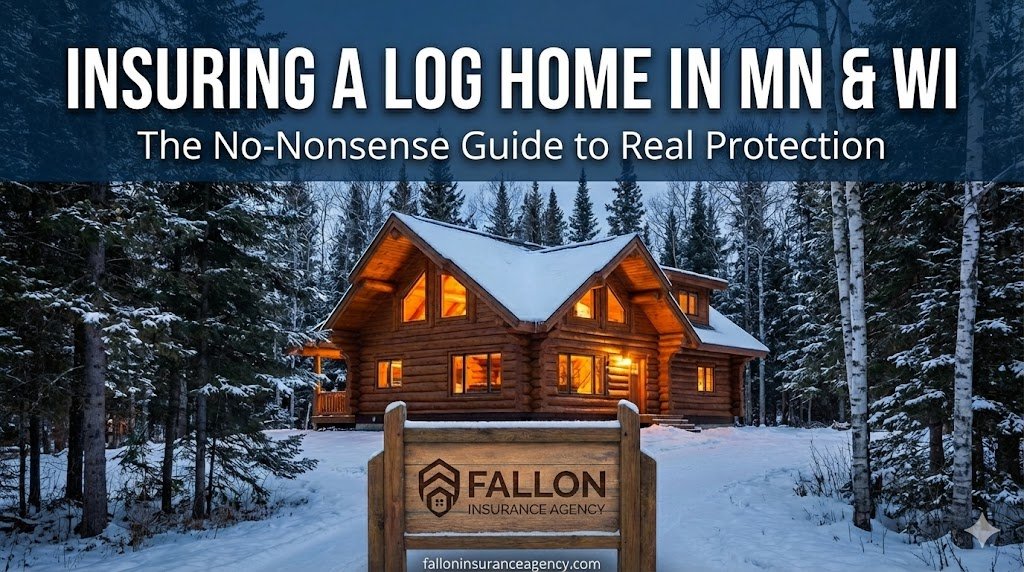
Owning a log home in the Upper Midwest is a dream lifestyle. Insuring it with “check-the-box” coverage is a nightmare waiting to happen. Here is why specialized properties demand specialized attention—and why Fallon Insurance Agency is the partner you need.
There is a specific romance to the Upper Midwest log home. Whether it’s perched on a bluff overlooking the St. Croix River in Wisconsin, nestled in the dense pines of Minnesota’s Northwoods, or serving as your primary residence outside of Rochester, a log home isn’t just a house. It’s a statement. It represents a connection to nature, craftsmanship, and a rustic durability that standard construction simply cannot match.
But that unique beauty comes with a complex reality: insurance.
If you’ve already tried to insure a log home, you’ve likely encountered frustration. You may have found that the big-name, direct-to-consumer insurance carrier you’ve used for years suddenly doesn’t want your business. Or perhaps they offered you a policy that felt generic, leaving you with a nagging suspicion that if the worst happened, the coverage wouldn’t truly be there.
At Fallon Insurance Agency, we say this frequently on our website because it’s true: We aren’t built for everyone. We are built for those who want more than check-the-box coverage.
If you own a log home in Minnesota or Wisconsin, “check-the-box” coverage is dangerous. You need smarter protection. Here is everything you need to know about why insuring a log structure is different, the pitfalls to avoid, and how to ensure your Northwoods dream doesn’t become a financial burden.
Why Standard Carriers Run from Log Homes?
To understand how to properly insure your home, you need to understand why many generalist insurance companies are terrified of them.
When a standard insurance carrier looks at a typical 2×4 stick-frame house with vinyl siding in a suburb, they know exactly what they are dealing with. The risk data is immense, the rebuilding costs are standardized, and the materials are uniform.
A log home breaks all their models. Here is the reality of the risk:
1. The Fire Risk Reality
While massive logs are actually quite difficult to ignite compared to thin framing lumber, once a log structure fully catches fire, it burns hotter and longer. Furthermore, the very appeal of a log home—a secluded spot in the woods—often means it is located further from a fire hydrant or a professional fire department. In insurance terms, this is a “Protection Class” issue. A volunteer fire department ten miles away is viewed very differently than a full-time station two blocks away.
2. The Rebuilding Nightmare
This is the single biggest issue. If a tornado rips through Wisconsin or a heavy snow load collapses a roof in Northern Minnesota, you cannot just hire a standard general contractor to fix it.
Log home repair and reconstruction require artisans. You need specialized labor skilled in stacking logs, intricate joinery, and understanding how logs settle over time. The materials themselves—massive white pine, cedar, or spruce logs—are expensive to source and transport. A standard insurance policy calculates rebuilding costs based on drywall and 2x4s; that math will leave you tens of thousands of dollars short if you need to rebuild a log wall.
3. Unique Maintenance Issues
Logs are organic. They move, they breathe, and, if untreated, they rot. They are also highly attractive to certain pests like carpenter bees and ants. Standard carriers see this higher maintenance requirement as a higher probability of a claim resulting from neglect.
The Trap of “Market Value” vs. “Replacement Cost”
If you only take one thing away from this article, let it be this section.
The biggest mistake log home owners make is accepting an insurance policy based on the home’s market value (what you could sell it for today) rather than its replacement cost (what it costs to rebuild it from scratch).
In many rural areas of MN and WI, a beautiful log cabin might have a market value of $450,000 based on recent area sales. However, if that home burns to the ground, clearing the massive debris and hiring specialist craftsmen to rebuild it exactly as it was might cost $750,000 due to specialized labor and material costs.
If your policy is capped at market value, you are out $300,000. That’s not insurance; that’s a financial disaster.
The Fallon Approach: Extended Replacement Cost
At Fallon Insurance Agency, we focus intensely on this gap. We don’t take shortcuts when calculating the true cost of reconstruction. Furthermore, we advocate for policies that include Extended Replacement Cost Coverage.
This feature provides an extra buffer (often 25% to 50% above the insured limit) to account for sudden surges in lumber prices or labor shortages after a major regional disaster. For a specialized asset like a log home, this isn’t an optional luxury; it’s essential armor.
The Minnesota & Wisconsin Winters Factor
Our local geography adds another layer of complexity to log home ownership. We don’t just deal with fires; we deal with brutal freeze-thaw cycles.
Ice Dams: Log homes can be susceptible to ice dams if the roof insulation and ventilation aren’t perfect. Because of the way log walls meet the roofline, water intrusion from an ice dam can travel deep into the logs themselves, causing hidden rot that might not be discovered for years.
Frozen Pipes: In rural getaway cabins that might sit empty for weeks in January, the risk of frozen and burst pipes is significant. Water damage in a log structure is harder to dry out than in a standard frame house, leading to mold issues deeper in the wood grain.
A generic homeowners policy might have exclusions for homes left unoccupied for certain periods, or caps on water damage that won’t cover the specialized drying required for logs. You need an agent who asks about how you use the property—is it a full-time residence or a weekend escape?—to ensure the policy matches the usage.
Maintenance: Your Role in Insurability
Getting great insurance for your log home isn’t just about what we do; it’s also about what you do. The best carriers—the ones offering the comprehensive coverage you need—want to see pride of ownership. They want to know you understand the asset you own.
To secure the best rates and ensure your claims aren’t denied due to “wear and tear,” you must stay on top of maintenance:
Chinking and Sealing: The mortar or synthetic sealant between the logs (chinking) must be kept in good repair to keep water and bugs out.
Stain and Preservative: Logs need to be regularly treated with UV inhibitors and water repellents. A gray, weathering log home looks rustic, but to an insurer, it looks neglected.
Clear Brush: Create a “defensible space” around your home. Clearing brush, dead trees, and woodpiles away from the structure is crucial, especially in forested areas of MN and WI prone to dry spells.
The Fallon Difference: Why Local Expertise Matters
If you are reading this and feeling overwhelmed, don’t be. The point isn’t to scare you away from log home ownership; it’s to ensure you enjoy it without a hidden cloud of financial risk hanging over your head.
This is why Fallon Insurance Agency exists.
We are proud to represent top-tier carriers like Farmers Insurance® in Minnesota and Wisconsin, which allows us access to underwriting teams that understand unique properties. We know which carriers will run from a hand-hewn log home, and which ones have the specialized programs to cover it correctly.
We have a track record of helping clients in this exact situation. As Barbara R. Eno, one of our valued clients, noted in her review:
“Leland came to rescue, saving us thousands for insuring our log home. Great service at a great price with firm we can trust.”
Barbara’s experience isn’t an anomaly; it’s our standard operating procedure. We don’t just provide a quote; we provide clarity. We review your property details, we understand the craftsmanship involved, and we build a policy that holds up when disaster strikes.
Stop Guessing. Start Protecting.
Your log home is likely one of the biggest investments of your life. Don’t insult that investment with cheap, inadequate insurance.
If you are currently insuring a log home in Minnesota or Wisconsin with a generic online carrier, or if you are in the process of buying one and are hitting brick walls with lenders requiring proof of insurance, it is time to talk to specialists.
We are local agents who actually answer the phone when you call. We know the difference between a full scribe fit and a chinked style home, and we know how to insure both.
Don’t settle for shortcuts. Get insurance that actually protects you.
Are you ready for smarter protection for your log home? Let’s get started.