


Why Auto Insurance Minneapolis MN Requires Local Expertise
Auto Insurance Minneapolis MN isn’t just about checking a box for the state—it’s about making sure your family and your savings are safe when the unthinkable happens. Whether you’re dealing with a blizzard on I-35W or the stop-and-go traffic downtown, your coverage needs to do more than just keep you legal.
Here is the reality for Minneapolis drivers:
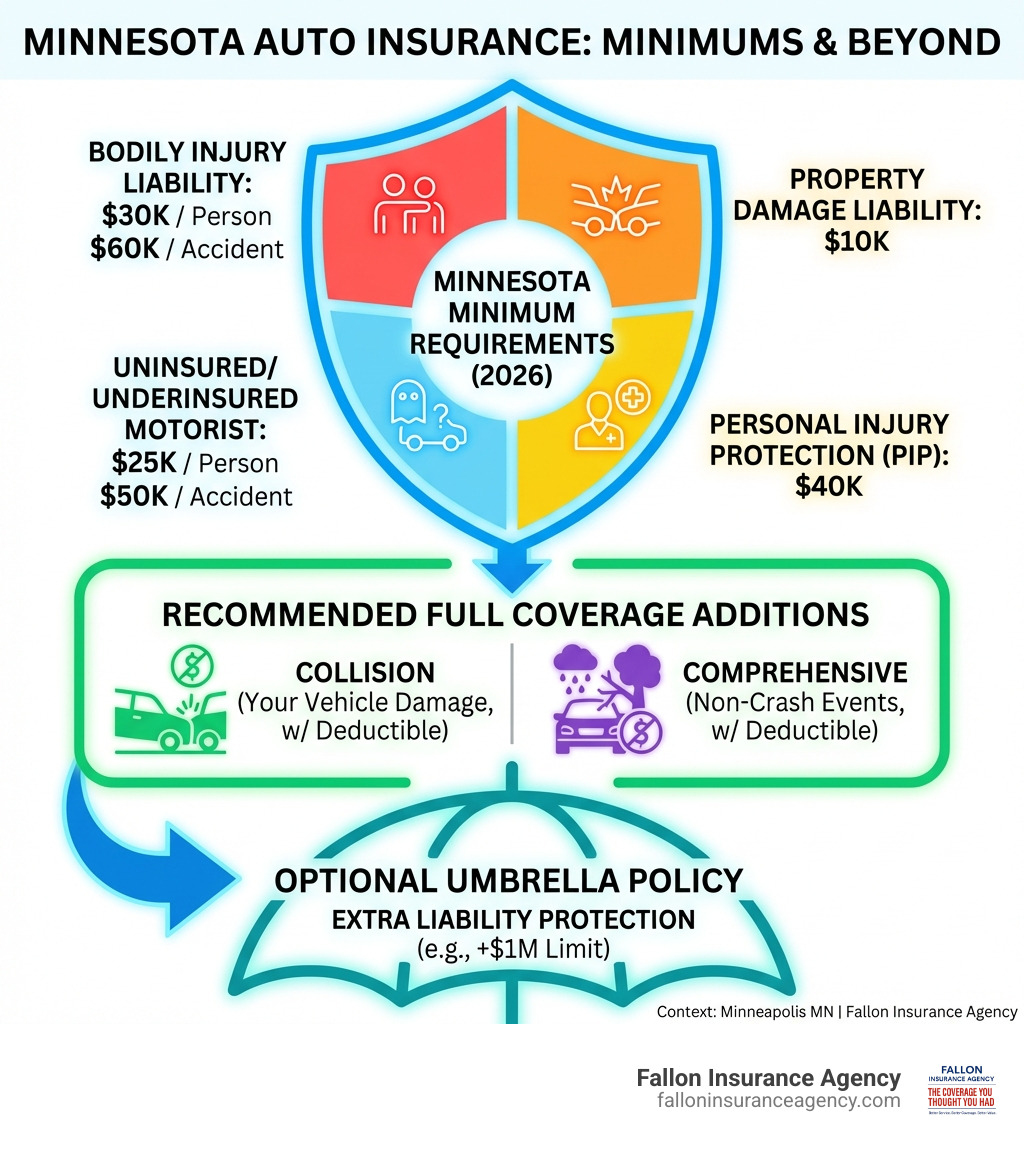
- Minimum required coverage: $30,000/$60,000 bodily injury liability, $10,000 property damage, $40,000 Personal Injury Protection (PIP), and $25,000/$50,000 uninsured/underinsured motorist.
- Average full coverage cost: $2,631 per year in Minneapolis (which is higher than the state average of $2,409).
- No-fault state: Minnesota requires PIP, so your own insurance pays your medical bills first, no matter who caused the wreck.
- Recommended limits: Most families need much higher liability protection than the state minimums to avoid losing their home or savings in a lawsuit.
The problem isn’t finding a policy—it’s understanding what that policy actually does when you’re standing on the side of the road. Too many people buy insurance that looks fine on a smartphone screen but fails when a serious injury occurs. In Minneapolis, with our high traffic density and winter hazards, the risks are just higher.
I’m Leland Fallon. I started Fallon Insurance Agency because I saw too many neighbors with Auto Insurance Minneapolis MN policies that left them wide open to financial ruin. We walk you through real-world scenarios before you sign, so you know exactly how you’re protected.
Finding the Best Auto Insurance Minneapolis MN
When you start looking for Auto Insurance Minneapolis MN, it’s easy to get overwhelmed by the sheer number of options. You see the national commercials promising to save you hundreds of dollars in fifteen minutes, but they rarely talk about what you’re actually buying. In a city like Minneapolis, where we deal with everything from massive hailstorms to icy pile-ups on the Crosstown, the “cheapest” policy can quickly become the most expensive mistake of your life.
We believe that navigating auto insurance should be a conversation, not a transaction. Finding the “best” policy isn’t just about the monthly premium; it’s about ensuring that if you are involved in a multi-car accident near U.S. Bank Stadium, your life savings aren’t at risk.
In Minneapolis, Minnesota, your insurance needs are unique. We have a higher density of vehicles, which means a higher statistical likelihood of a collision. We also have high rates of vehicle theft and vandalism in certain ZIP codes, which makes physical damage coverage essential. When we compare policies, we aren’t just looking at the price tag. We are looking at the carrier’s reputation for claims handling and whether the liability limits actually protect your assets, like your home and your future earnings.

Minimum Requirements for Auto Insurance Minneapolis MN
Minnesota law is very clear about what you must have to legally drive. According to Minnesota Statutes 65B.48, every vehicle owner must maintain “no-fault” insurance. If you’re caught driving without it, you’re looking at fines, potential jail time, and the loss of your license.
The state-mandated minimums for auto insurance in Minnesota are:
- Bodily Injury Liability: $30,000 per person / $60,000 per accident. This pays for injuries you cause to others.
- Property Damage Liability: $10,000 per accident. This pays for damage you cause to someone else’s property (like their car or a fence).
- Personal Injury Protection (PIP): $40,000 per person ($20,000 for medical expenses and $20,000 for economic loss like lost wages).
- Uninsured/Underinsured Motorist Coverage: $25,000 per person / $50,000 per accident. This protects you if you’re hit by someone who has no insurance or not enough insurance.
Here is the honest truth: $10,000 in property damage liability is almost nothing in today’s world. If you rear-end a new SUV in downtown Minneapolis, $10,000 won’t even cover the bumper and the sensor tech, let alone a totaled vehicle. You would be personally responsible for the difference. That is why we rarely, if ever, recommend state minimums.
Understanding Full Coverage in the Twin Cities
You’ll often hear the term “full coverage,” but it’s important to know that this isn’t a legal term. Usually, when people say full coverage, they mean they have the state-required liability plus collision and comprehensive coverage.
- Collision Insurance: This pays to fix your car if you hit another vehicle or an object, regardless of who is at fault. In the Twin Cities, this is vital for those unexpected winter slides into a guardrail.
- Comprehensive Coverage: This handles “acts of God” or things out of your control. Think about a tree limb falling on your car during a summer storm, or the frequent need for deer season and auto insurance protection. It also covers theft, fire, and vandalism.
- Glass Repair: Many Minneapolis drivers opt for “Full Glass” coverage. With the amount of salt and gravel on our roads in the winter, cracked windshields are almost a rite of passage.
If you are leasing or financing your car, your lender will absolutely require both collision and comprehensive. They want to protect their investment. But even if your car is paid off, you have to ask yourself: “If my car was totaled tomorrow, could I afford to write a check for a replacement?” If the answer is no, you need these coverages.
Why Minnesota’s No-Fault System Matters to You
Minnesota has been a no-fault state since 1975. There is a common myth that “no-fault” means no one is blamed for an accident. That’s not true. Police and insurance companies still determine who caused the crash for liability purposes.
What “no-fault” actually refers to is how medical bills are paid. Under the background on no-fault auto insurance rules, your own insurance company pays for your medical expenses, lost wages, and replacement services (like house cleaning if you’re too injured to do it) regardless of who caused the accident. This is handled through your Personal Injury Protection (PIP).
This system was designed to get people medical care quickly without waiting for a long legal battle to decide who was at fault. However, PIP has limits. If your medical bills exceed your PIP limits, or if you meet certain “thresholds” (like permanent disfigurement or disability), you can still sue the at-fault driver for pain and suffering.
Understanding how auto insurance works within this no-fault framework is critical. If you have a basic policy with only $20,000 in medical PIP and you spend three days in a Minneapolis hospital after a wreck, that money will be gone before you even get discharged. We help our clients look at their health insurance and their PIP limits together to make sure there are no gaps that could leave them with massive medical debt.
Beyond the Basics: Why We Don’t Sell Minimum Coverage
At Fallon Insurance Agency, we take a different path. We’ve seen what happens when “cheap” insurance meets a real-life disaster. We’ve seen families lose their homes because they chose a $50,000 liability limit but faced a $500,000 judgment after a serious crash.
We don’t sell minimum coverage because it isn’t true protection—it’s a gamble with your future. Instead, we focus on scenario planning. We ask: “What happens if you hit a patch of black ice on I-94 and cause a pileup?” If your limits are too low, other drivers can sue you for your personal assets.
This is where an Umbrella Policy comes in. It provides an extra layer of liability protection (usually starting at $1 million) that sits on top of your auto and home insurance. If you’re liable for a major accident, the umbrella policy kicks in after your auto limits are gone. It is a straightforward way to protect everything you’ve worked for.
We also talk to our clients about what accident forgiveness actually means. It’s a helpful feature, but it doesn’t replace the need for solid limits. For business owners, we make sure you have the best commercial auto insurance in Minnesota because a personal policy will almost always deny a claim if you were working at the time of the accident.
Recommended Limits for Auto Insurance Minneapolis MN
To truly protect your family, you need more than the 30/60/10 state minimums. For most Minneapolis families, we recommend at least 100/300/100 limits:
- $100,000 per person for bodily injury.
- $300,000 per accident for bodily injury.
- $100,000 for property damage.
If you own a home in a neighborhood like Linden Hills or North Loop, these limits might still be too low. You should likely consider higher limits or an umbrella policy.
We also suggest looking into 100-mile towing coverage. If you break down in a blizzard, a 5-mile tow won’t get you very far. You want the ability to get your vehicle to a mechanic you trust or back to your driveway. These are the details we cover in our consultations. We want you to understand the “why” behind your coverage, not just the cost.
Factors That Impact Your Rates in the Twin Cities
Why does your neighbor pay less for insurance than you do? There are dozens of factors that go into your Auto Insurance Minneapolis MN premium.
- ZIP Codes: This is a big one. Insurance companies look at the frequency of claims in your specific area. A driver in the 55407 ZIP code might see a median full coverage rate of $3,179, while someone in a quieter suburb might pay significantly less. Higher rates of theft, vandalism, and accidents in dense urban areas naturally drive up costs.
- Driving History: This is obvious, but it’s not just about tickets. Insurance companies look at “at-fault” accidents. Even a small fender bender can impact your rates for three to five years.
- Vehicle Type: A car with high-end safety features might earn you a discount, but it might also be more expensive to repair. Carriers look at the “loss history” of your specific make and model.
- Annual Mileage: If you commute from Lakeville to downtown Minneapolis every day, you’re on the road more than someone who works from home in Eagan. More time on the road equals more risk.
- Bundling: One of the most effective ways to lower your rate is to bundle your auto insurance with your homeowners or renters policy. We often see savings of 20% or more when policies are combined.
- Credit History: In Minnesota, insurance companies are allowed to use your credit-based insurance score to help determine your premium. Drivers with higher scores generally pay lower rates.
While we can’t change your ZIP code, we can help you find every possible discount. Whether it’s a “good student” discount for your teenager or a “away at school” discount, we dig into the details. For those looking to compare, it can be helpful to see a guide to paying less in neighboring regions like Wisconsin to understand how geography affects the math.
Frequently Asked Questions about Minneapolis Car Insurance
What should I do immediately after a car accident in Minnesota?
First, make sure everyone is safe and call 911 if there are injuries. In Minnesota, you are required to stop and exchange information. Take photos of the damage, the license plates, and the scene. Use an app like WreckCheck if you have it to document everything. Because Minnesota is a no-fault state, you should contact your own insurance agent as soon as possible to start your PIP claim for any medical needs. You have six months to file a PIP claim, but sooner is always better.
Why is my auto insurance rate higher in Minneapolis than in rural Minnesota?
It comes down to risk density. In Minneapolis, there are more cars, more intersections, more pedestrians, and unfortunately, higher rates of vehicle-related crime. If you live in a rural area with one stoplight and ten neighbors, the statistical chance of you hitting someone is much lower than if you’re driving through the Lowry Hill Tunnel every morning.
Can I lower my premium without reducing my liability limits?
Yes! We never recommend cutting your liability limits to save money—that’s like cutting your parachute to save weight. Instead, consider raising your deductible. Moving from a $250 deductible to a $500 or $1,000 deductible can lower your premium by 15% to 30%. Just make sure you have that deductible amount sitting in a savings account just in case. You can also look for discounts related to defensive driving courses or telematics programs that track safe driving habits.
Conclusion
At Fallon Insurance Agency, we don’t treat insurance like a generic product. We help families and business owners across Minnesota and Wisconsin—from Cannon Falls and Rochester to Duluth and the Twin Cities—make smarter insurance decisions with fewer surprises.
Our approach is simple: protection first. We’ll tell you when a low limit is a real risk, even if it saves money today. We’ll walk through the situations that actually happen here—a winter pileup, a totaled vehicle, a serious injury claim—so you understand what your policy does before you ever need to use it.
If you’re tired of guessing, let’s talk. We’ll review what you have, explain your options in plain language, and help you choose coverage that protects your family and your savings.
Get a quote for Auto Insurance Minnesota

Leland Fallon
Leland Fallon is the Founder of Fallon Insurance Agency, serving Minnesota and Wisconsin families and business owners with personalized home, auto, commercial, and life insurance solutions. His mission is simple: protect what matters most. With a focus on clear guidance, strong coverage, and long-term relationships, Leland helps clients make confident insurance decisions — not rushed ones.