



Why Smart Shoppers Use a Comprehensive Car Insurance Quote Comparison
Comprehensive car insurance quote comparison can save you over $2,160 per year, yet most drivers never compare rates beyond their initial policy. The difference between the most expensive and least expensive carrier for the same coverage often exceeds $180 per month—money that could stay in your pocket simply by investing 15 minutes in a proper comparison.
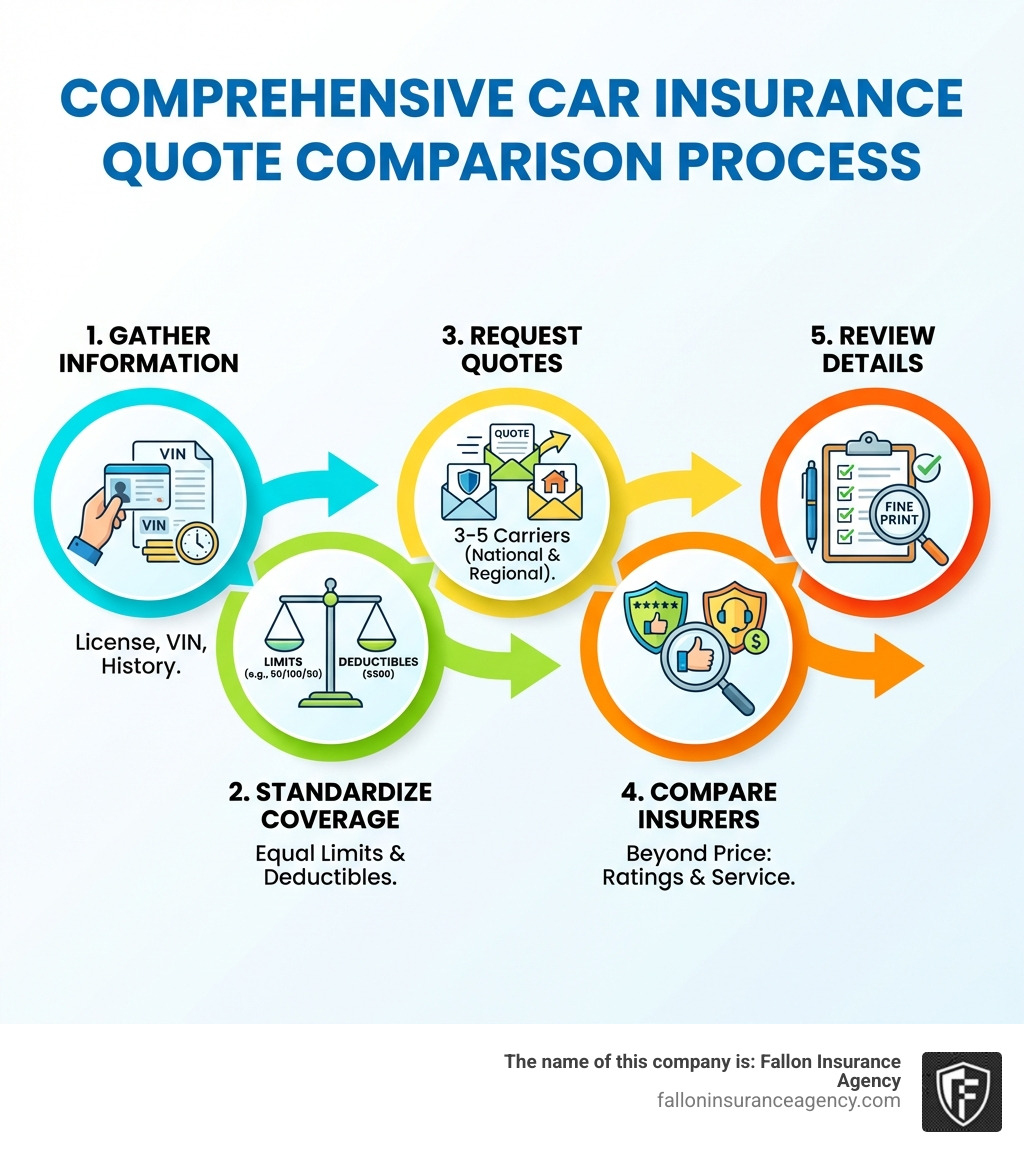
Quick Answer: How to Compare Comprehensive Car Insurance Quotes
- Gather your information – Driver’s license, VIN, current policy declaration page, driving history
- Standardize coverage limits – Use identical liability limits (like 50/100/50) and deductibles ($500) across all quotes
- Request quotes from 3-5 carriers – Include both national insurers and regional providers in your state
- Compare beyond price – Evaluate financial strength ratings, customer satisfaction scores, and claims handling reputation
- Review coverage details – Verify comprehensive deductibles, exclusions, and optional coverages match across quotes
Car insurance costs jumped 8.3% in the first half of 2025 compared to the prior year, making quote comparison more critical than ever. Full coverage (liability + comprehensive + collision) costs an average of $2,271 annually, but rates vary dramatically by company—from as low as $1,580 with some carriers to over $3,900 with others for identical coverage.
The challenge isn’t just finding the cheapest rate. It’s ensuring you’re comparing equivalent protection levels while evaluating each insurer’s ability to pay claims, provide responsive service, and offer the specific coverages your vehicles and family need.
I’m Leland Fallon, founder of Fallon Insurance Agency, and I’ve helped hundreds of Minnesota and Wisconsin families navigate comprehensive car insurance quote comparisons to find protection that fits both their coverage needs and budgets. Through my work with multiple carriers across the Midwest, I’ve seen how proper quote comparison uncovers savings opportunities most drivers miss.
Why a comprehensive car insurance quote comparison is Essential in 2026

If you haven’t looked at your policy in the last twelve months, you are likely paying a “loyalty penalty.” In 2025, car insurance costs rose by 8.3% nationwide. For drivers in Minnesota and Wisconsin, these increases can be even more pronounced due to our unique weather patterns and regional risks. A comprehensive car insurance quote comparison isn’t just a way to save a few bucks; it’s a necessary financial audit in an era of rising premiums.
According to J.D. Power’s auto insurance study, customer satisfaction is often tied directly to the perceived value of the policy. When rates climb, that value perception drops. The reality is that insurance companies change their pricing algorithms frequently. A company that was the cheapest for you three years ago might now be the most expensive because they’ve adjusted how they view your ZIP code or your vehicle type.
The High Cost of Staying Put
Many drivers believe that staying with the same company for a decade earns them significant discounts. While “loyalty discounts” exist, they rarely offset the base rate increases that occur over time. Research shows that average full coverage rates can vary by $2,160 or more per year between companies for the exact same driver profile.
By failing to perform a comprehensive car insurance quote comparison, you are essentially leaving thousands of dollars on the table. Understanding the market shifts is part of navigating auto insurance effectively. We often see clients save enough to cover their utility bills for several months just by switching to a carrier that better fits their current life stage.
| Coverage Type | Average Monthly Cost | Key Benefits |
|---|---|---|
| Liability-Only | $76 | Meets legal requirements; covers others’ damage. |
| Full Coverage | $208 | Includes Comprehensive & Collision; protects your car. |
| Difference | $132 | The “Peace of Mind” premium for your own asset. |
Key Factors That Influence Your Comprehensive Coverage Rates
When you start a comprehensive car insurance quote comparison, you’ll notice that prices aren’t just pulled out of thin air. Actuaries use a massive amount of data to determine how “risky” you are. This includes everything from your driving record to the technology inside your car.
For example, Vehicle Safety/Recall Information can impact your rates. If your vehicle has a known defect or a high theft rate, your comprehensive coverage (which covers non-collision events) will naturally be higher.
The Impact of Credit and Demographics
In Minnesota and Wisconsin, credit-based insurance scores play a massive role in what you pay. Statistics show that drivers with poor credit can face premium hikes of 47% to 86% compared to those with excellent credit. This is because data suggests a correlation between credit management and risk management on the road.
Age is another heavy hitter. A 40-year-old driver pays an average of $189 per month for full coverage, while a 16-year-old driver can expect to pay nearly triple that. As we discuss in our auto insurance overview, your demographic profile sets the “base” for your quote before any discounts are applied.
Vehicle-Specific Rating Factors
Your VIN (Vehicle Identification Number) tells the insurer everything they need to know about the cost of repairing your car. If you drive a vehicle with expensive LED headlights and specialized sensors, a simple fender bender—or even a hail storm—could cost thousands more to fix than a base-model sedan.
In our neck of the woods, we also have to consider nature. Comprehensive coverage is what protects you if you hit a deer—a very real concern in Cannon Falls or Eau Claire. Understanding deer season and auto insurance is a local necessity that influences how we help you compare quotes.
How to Perform an Apples-to-Apples comprehensive car insurance quote comparison
The biggest mistake people make during a comprehensive car insurance quote comparison is comparing a “Basic” policy from one company to a “Premium” policy from another. To get a true sense of value, you must standardize your limits. If Company A quotes you $500 deductibles and Company B quotes you $1,000, Company B will look cheaper—but you’re taking on more financial risk.
Beyond the numbers, look at the company’s reputation. The NAIC Complaint Index is a great tool for this. It shows how many complaints a company receives relative to its size. A low price is great, but if the company has a high complaint rate regarding claims, that “cheap” policy could become very expensive when you actually need to use it.
Information Needed for a comprehensive car insurance quote comparison
To get the most accurate numbers when you get a quote, have the following ready:
- Driver’s License Numbers: For all drivers in the household.
- VINs: For all vehicles you want to insure.
- Storage Address: Where the car is parked at night (garaged vs. street parking matters!).
- Annual Mileage: An accurate estimate of how much you drive.
- Current Dec Page: This shows your current limits so you can match them.
Standardizing Limits for a comprehensive car insurance quote comparison
We recommend using these “standard” limits for a fair comparison:
- Liability: 50/100/50 (This means $50,000 per person, $100,000 per accident for bodily injury, and $50,000 for property damage).
- Deductibles: Set both Comprehensive and Collision to $500.
- Uninsured/Underinsured Motorist: Match this to your liability limits.
Don’t forget to check for features like accident forgiveness. Knowing what accident forgiveness actually means can help you decide if a slightly higher premium is worth the protection against future rate hikes.
Evaluating Insurers Beyond the Premium Price
A comprehensive car insurance quote comparison should involve more than just looking at the bottom-line price. You are buying a promise that the company will be there when things go wrong.
Check the financial strength of the carrier. Companies with high ratings from AM Best or similar agencies have the “deep pockets” necessary to pay out claims even after major catastrophes (like the massive hailstorms we sometimes see in the Midwest). You should also look for “perks” that add real value, such as 100-mile towing coverage, which can be a lifesaver if you’re traveling between Rochester and the Twin Cities.
Methods for Obtaining Quotes
There are three main ways to shop:
- Direct from Insurers: You visit each website individually. This is time-consuming but gives you direct control.
- Comparison Websites: These tools aggregate data from multiple carriers. Be careful, as some are “lead-gen” sites that may sell your data to dozens of callers.
- Independent Agents: This is what we do at Fallon Insurance Agency. We have access to 20+ top-rated carriers and do the “apples-to-apples” comparison for you. We often use assumed credit ratings during the initial phase to protect your data privacy, only running a full report when you’re ready to finalize.
Frequently Asked Questions about Car Insurance Quotes
What is the distinction between an initial quote and the final policy rate?
An initial quote is an estimate based on the information you provided. The final policy rate is determined after “underwriting.” This is when the insurance company verifies your driving history through the DMV and checks your claims history through a database called LexisNexis. If you forgot to mention a minor speeding ticket from three years ago, or if the VIN reveals the car has a salvage title, the final rate will likely be higher than the initial quote.
How do deductibles affect my monthly comprehensive premium?
Your deductible is the amount you pay out-of-pocket before insurance kicks in.
- Higher Deductible ($1,000): Lowers your monthly premium because you are taking on more of the risk.
- Lower Deductible ($250): Increases your monthly premium but makes a claim less painful for your bank account.
In our experience, if you have a healthy emergency fund, a $1,000 deductible is a great way to save on your comprehensive car insurance quote comparison. If money is tight, a $250 or $500 deductible is safer.
How often should I compare car insurance quotes to find the best deal?
We recommend a full comprehensive car insurance quote comparison every 12 months or whenever you have a major life change. Life changes include:
- Moving to a new ZIP code (e.g., moving from Hudson, WI to Rochester, MN).
- Buying a new vehicle.
- Adding a teen driver to the policy.
- Getting married or divorced.
- Improving your credit score significantly.
Conclusion
At Fallon Insurance Agency, we believe that you shouldn’t have to choose between affordable rates and high-quality protection. Whether you are in Cannon Falls, Eau Claire, or anywhere in between, we specialize in making the comprehensive car insurance quote comparison process simple and transparent.
Don’t let rising premiums eat away at your budget. By standardizing your limits and shopping around, you can secure smarter, more affordable coverage that protects your family’s future. Find the best rates for your vehicle today and see how much you could be saving.

Leland Fallon
Leland Fallon is the founder of Fallon Insurance Agency, dedicated to protecting families across the Midwest. His mission is simple: make sure no family ever finds out they were underinsured after it’s too late. By uncovering hidden coverage gaps, he ensures his clients are fully protected not just carrying a policy.